


Page 447 - Carbonate Facies in Geologic History
P. 447
436

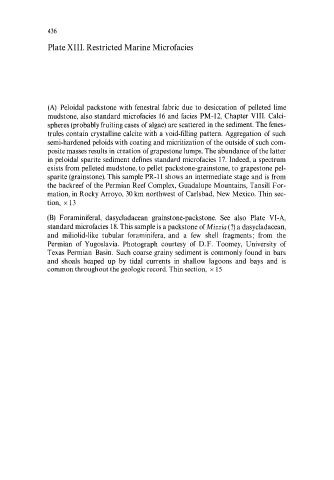
               Plate XIII. Restricted Marine Microfacies


               (A)  Peloidal packstone with fenestral  fabric  due  to desiccation  of pelleted lime
               mudstone, also standard microfacies  16 and facies  PM-12,  Chapter VIII.  Calci-
               spheres (probably fruiting cases of algae) are scattered in the sediment. The fenes-
               trules contain crystalline calcite with a void-filling pattern.  Aggregation  of such
               semi-hardened peloids with coating and micritization of the outside of such com-
               posite masses results in creation of grapestone lumps. The abundance of the latter
               in peloidal sparite sediment defines standard microfacies  17.  Indeed, a spectrum
               exists from pelleted mudstone, to pellet packstone-grainstone, to grapestone pel-
               sparite (grainstone). This sample PR-ll shows an intermediate stage and is from
               the backreef of the Permian Reef Complex, Guadalupe Mountains, Tansill For-
               mation, in Rocky Arroyo, 30 km northwest of Carlsbad, New  Mexico. Thin sec-
               tion,  x 13
               (B)  Foraminiferal,  dasyc1adacean  grainstone-packstone.  See  also  Plate  VI-A,
               standard microfacies 18. This sample is a packstone of Mizzia (?) a dasyc1adacean,
               and  miliolid-like  tubular  foraminifera,  and  a  few  shell  fragments;  from  the
               Permian  of  Yugoslavia.  Photograph  courtesy  of  D.F.  Toomey,  University  of
               Texas Permian  Basin.  Such coarse grainy sediment is  commonly found  in  bars
               and  shoals  heaped  up  by  tidal  currents  in  shallow  lagoons  and  bays  and  is
               common throughout the geologic record. Thin section,  x 15

