


Page 159 - Chemical and process design handbook
P. 159
Speight_Part II_B  11/7/01  3:11 PM  Page 2.100


                  2.100                 MANUFACTURE OF CHEMICALS

                                          Methyl alcohol recycle

                   Makeup  Methyl
                    methyl  alcohol                      Tetrahydrofuran    Butanediol
                    alcohol                        Fixed-bed reactor


                              Reaction column
                  Maleic
                  anhydride        Water     Vaporizer         Distillation  Distillation  Distillation


                                             High molecular
                                             weight material


                                           Ester recycle
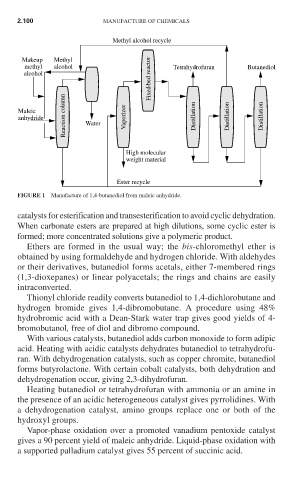
                  FIGURE 1  Manufacture of 1,4-butanediol from maleic anhydride.

                  catalysts for esterification and transesterification to avoid cyclic dehydration.
                  When carbonate esters are prepared at high dilutions, some cyclic ester is
                  formed; more concentrated solutions give a polymeric product.
                    Ethers are formed in the usual way; the  bis-chloromethyl ether is
                  obtained by using formaldehyde and hydrogen chloride. With aldehydes
                  or their derivatives, butanediol forms acetals, either 7-membered rings
                  (1,3-dioxepanes) or linear polyacetals; the rings and chains are easily
                  intraconverted.
                    Thionyl chloride readily converts butanediol to 1,4-dichlorobutane and
                  hydrogen bromide gives 1,4-dibromobutane. A procedure using 48%
                  hydrobromic acid with a Dean-Stark water trap gives good yields of 4-
                  bromobutanol, free of diol and dibromo compound.
                    With various catalysts, butanediol adds carbon monoxide to form adipic
                  acid. Heating with acidic catalysts dehydrates butanediol to tetrahydrofu-
                  ran. With dehydrogenation catalysts, such as copper chromite, butanediol
                  forms butyrolactone. With certain cobalt catalysts, both dehydration and
                  dehydrogenation occur, giving 2,3-dihydrofuran.
                    Heating butanediol or tetrahydrofuran with ammonia or an amine in
                  the presence of an acidic heterogeneous catalyst gives pyrrolidines. With
                  a dehydrogenation catalyst, amino groups replace one or both of the
                  hydroxyl groups.
                    Vapor-phase oxidation over a promoted vanadium pentoxide catalyst
                  gives a 90 percent yield of maleic anhydride. Liquid-phase oxidation with
                  a supported palladium catalyst gives 55 percent of succinic acid.

