


Page 228 - Chemical and process design handbook
P. 228
Speight_Part II_C  11/7/01  3:08 PM  Page 2.168


                                  CHLOROPRENE


                                                o
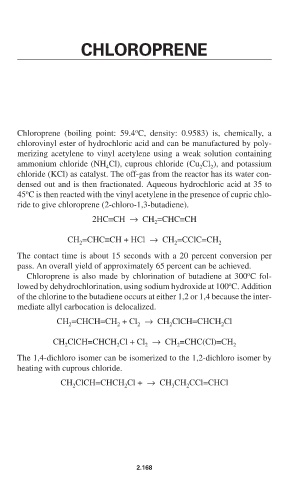
                  Chloroprene (boiling point: 59.4 C, density: 0.9583) is, chemically, a
                  chlorovinyl ester of hydrochloric acid and can be manufactured by poly-
                  merizing acetylene to vinyl acetylene using a weak solution containing
                  ammonium chloride (NH Cl), cuprous chloride (Cu Cl ), and potassium
                                         4                      2  2
                  chloride (KCl) as catalyst. The off-gas from the reactor has its water con-
                  densed out and is then fractionated. Aqueous hydrochloric acid at 35 to
                    o
                  45 C is then reacted with the vinyl acetylene in the presence of cupric chlo-
                  ride to give chloroprene (2-chloro-1,3-butadiene).
                                     2HC≡CH  → CH =CHC≡CH
                                                     2
                               CH =CHC≡CH + HCl  → CH =CClC=CH
                                  2                       2          2
                  The contact time is about 15 seconds with a 20 percent conversion per
                  pass. An overall yield of approximately 65 percent can be achieved.
                                                                             o
                    Chloroprene is also made by chlorination of butadiene at 300 C fol-
                                                                        o
                  lowed by dehydrochlorination, using sodium hydroxide at 100 C. Addition
                  of the chlorine to the butadiene occurs at either 1,2 or 1,4 because the inter-
                  mediate allyl carbocation is delocalized.
                            CH =CHCH=CH + Cl → CH ClCH=CHCH Cl
                               2           2     2       2            2

                           CH ClCH=CHCH Cl + Cl → CH =CHC(Cl)=CH
                              2            2       2       2             2
                  The 1,4-dichloro isomer can be isomerized to the 1,2-dichloro isomer by
                  heating with cuprous chloride.
                             CH ClCH=CHCH Cl +  → CH CH CCl=CHCl
                                2            2           3   2


                                                2.168

