


Page 468 - Construction Waterproofing Handbook
P. 468
12.8   CHAPTER TWELVE
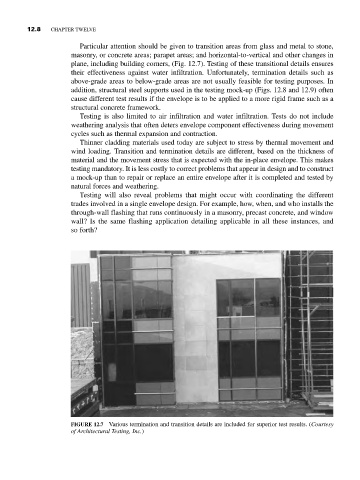
                         Particular attention should be given to transition areas from glass and metal to stone,
                      masonry, or concrete areas; parapet areas; and horizontal-to-vertical and other changes in
                      plane, including building corners, (Fig. 12.7). Testing of these transitional details ensures
                      their effectiveness against water infiltration. Unfortunately, termination details such as
                      above-grade areas to below-grade areas are not usually feasible for testing purposes. In
                      addition, structural steel supports used in the testing mock-up (Figs. 12.8 and 12.9) often
                      cause different test results if the envelope is to be applied to a more rigid frame such as a
                      structural concrete framework.
                         Testing is also limited to air infiltration and water infiltration. Tests do not include
                      weathering analysis that often deters envelope component effectiveness during movement
                      cycles such as thermal expansion and contraction.
                         Thinner cladding materials used today are subject to stress by thermal movement and
                      wind loading. Transition and termination details are different, based on the thickness of
                      material and the movement stress that is expected with the in-place envelope. This makes
                      testing mandatory. It is less costly to correct problems that appear in design and to construct
                      a mock-up than to repair or replace an entire envelope after it is completed and tested by
                      natural forces and weathering.
                         Testing will also reveal problems that might occur with coordinating the different
                      trades involved in a single envelope design. For example, how, when, and who installs the
                      through-wall flashing that runs continuously in a masonry, precast concrete, and window
                      wall? Is the same flashing application detailing applicable in all these instances, and
                      so forth?


                      FIGURE 12.7 Various termination and transition details are included for superior test results. (Courtesy
                      of Architectural Testing, Inc.)

