


Page 245 - Cultural Competence in Health Education
P. 245
Culture and Sexual Orientation  223


                       including the spread of viral infections (such as HIV and hepatitis). It can also lead to
                       systemic illness and disfigurement and even death in some cases. The use of hormones

                       acquired illegally on the street is also extremely dangerous (National Coalition for
                       LGBT Health, 2004).
                            Along with not obtaining health care because of lack of insurance or not wanting
                       to be diagnosed with GID, there are other reasons why transgender people do not
                       obtain health care. Health educators and professionals may be transphobic in addi-
                       tion to homophobic. Additionally, not all transgender people are aware of the health
                       needs that are important for them to address, given their identity and whether or not
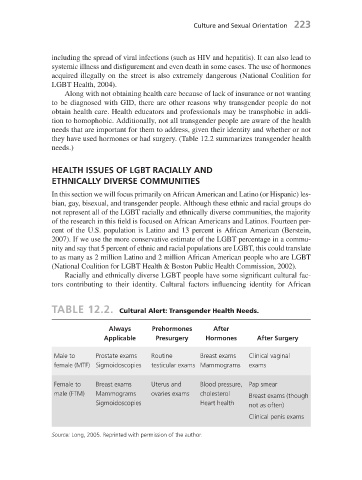
                       they have used hormones or had surgery. (Table  12.2  summarizes transgender health
                       needs.)

                           HEALTH ISSUES OF  LGBT  RACIALLY AND
                       ETHNICALLY DIVERSE COMMUNITIES

                         In this section we will focus primarily on African American and Latino (or Hispanic) les-
                       bian, gay, bisexual, and transgender people. Although these ethnic and racial groups do
                       not represent all of the LGBT racially and ethnically diverse communities, the majority

                       of the research in this field is focused on African Americans and Latinos. Fourteen per-
                       cent of the U.S. population is Latino and 13 percent is African American (Berstein,
                       2007). If we use the more conservative estimate of the LGBT percentage in a commu-
                       nity and say that 5 percent of ethnic and racial populations are LGBT, this could translate
                       to as many as 2 million Latino and 2 million African American people who are LGBT
                       (National Coalition for LGBT Health  &  Boston Public Health Commission, 2002).

                            Racially and ethnically diverse LGBT people have some significant cultural fac-

                       tors contributing to their identity. Cultural factors influencing identity for African

                       TABLE 12.2.  Cultural Alert: Transgender Health Needs.

                                      Always      Prehormones       After
                                       Applicable   Presurgery     Hormones     After Surgery

                       Male to     Prostate exams   Routine     Breast exams   Clinical vaginal
                       female (MTF) Sigmoidoscopies    testicular exams Mammograms  exams


                       Female to   Breast exams   Uterus and    Blood  pressure,  Pap smear
                       male (FTM)  Mammograms     ovaries exams    cholesterol   Breast exams (though
                                   Sigmoidoscopies              Heart health  not as often)
                                                                             Clinical penis exams


                       Source: Long, 2005. Reprinted with permission of the author.


                                                                                                  7/1/08   3:03:34 PM
          c12.indd   223
          c12.indd   223                                                                          7/1/08   3:03:34 PM

