


Page 136 - Curvature and Homology
P. 136
118     111.  RIEMANNIAN  MANIFOLDS:  CURVATURE, HOMOLOGY
        at P from which  we conclude that F(a) is  a positive  definite quadratic
        form. We thus obtain the following generalization of cor., theorem 3.2.4:

        Theorem 3.9.1.  The  betti  numbers  b,(O  < p < n)  of  a  compact  and
        orientable conformally flat  Riemannian  mani$old  of  positive  definite Ricci
        curvature vanish  [6,51].
          For  n = 2,3  this  is,  of  course,  evident  from  theorem  3.2.1  and
        Poincart duality.
          If M is a Riemannian manifold which is not conformally flat, that is,
        if  for  n > 3  its  conformal curvature  tensor  does not  vanish,  we  may
        introduce  a  quantity  which  measures  its  deviation  from  conformal
        flatness and ask under what conditions M remains a homology sphere.
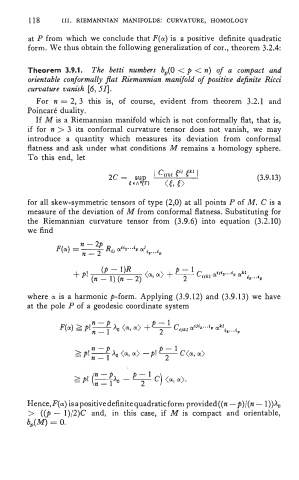
        To this end,  let


        for all skew-symmetric tensors of  type (2,O) at all points P of  M.  C is a
        measure of the deviation of  M from conformal flatness. Substituting for
        the  Riemannian  curvature  tensor  from  (3.9.6)  into  equation  (3.2.10)
        we find


                         (P - 1)R          P-1
                                  2) (a, a) + 7  akzC...i,,
                   +P! (n - l)(n -              Ct(kl   &ia...ip
        where a is a harmonic p-form.  Applying (3.9.12)  and (3.9.13)  we  have
        at the pole P of  a geodesic coordinate system


                   2 p!        -      c) (a, a).
                                 p+

        Hence, F(a) is a positive definite quadratic form provided ((n  - p)/(n - I))&
        > ((p - 1)/2)C  and,  in  this  case,  if  M is  compact  and  orientable,
        b,(M)  = 0.

