


Page 204 - Curvature and Homology
P. 204
186                  V.  COMPLEX  MANIFOLDS

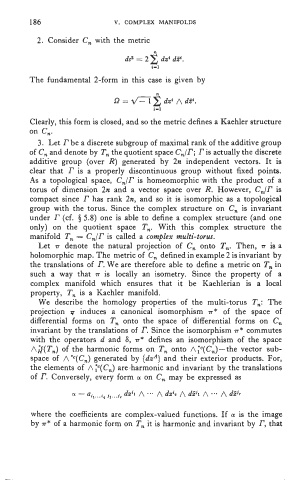
          2.  Consider C,,  with the metric


        The fundamental 2-form  in this case is given by


        Clearly, this form is closed, and so the metric defines a Kaehler structure
        on  C,.
          3.  Let r be a discrete subgroup of  maximal rank of the additive group
        of C,, and denote by T,  the quotient space Ci/l'; I' is actually the discrete
        additive  group  (over  R)  generated  by  2n  independent  vectors.  It  is
        clear  that  l'  is  a  properly  discontinuous  group  without  fixed  points.
        As  a  topological  space,  C,/r  is  homeomorphic with  the  product  of  a
        torus of  dimension  2n  and  a  vector  space over  R.  However,  CJI'  is
        compact since r has rank  2n,  and so it is isomorphic as a topological
        group  with  the torus.  Since the complex structure on  C,  is invariant
        under  l' (cf.  5 5.8) one is able to define a complex structure (and one
         only)  on  the  quotient  space  T,.  With  this  complex  structure  the
         manifold  T,  = C,/r  is  called a complex  multi-torus.
           Let  n denote  the  natural  projection  of  C,,  onto  T,.  Then,  n is a
         holomorphic map. The metric of  Cn defined in example  2 is invariant by
         the translations of  r. We are therefore able to define a metric on T,  in
         such  a  way  that  n is  locally  an  isometry.  Since  the  property  of  a
         complex  manifold  which  ensures  that  it  be  Kaehlerian  is  a  local
         property,  T,  is  a  Kaehler  manifold.
           We  describe  the  homology  properties  of  the  multi-torus  T,:  The
         projection  7  induces  a  canonical  isomorphism  n* of  the  space  of
         differential forms  on  T,  onto  the  space  of  differential forms  on  C,
         invariant by the translations of  I'.  Since the isomorphism n* commutes
         with  the  operators  d and  8,  n* defines  an  isomorphism  of  the  space
         AZ(T,,)  of  the harmonic forms on  T,  onto  AiC(Cn)-the  vector  sub-
         space of  A*c(C,)  generated by  (dzA) and  their exterior  products.  For,
         the elements of  A p(C,)  are-harmonic and  invariant  by the translations
         of l'. Conversely, every form a on  C,  may be expressed as


         where  the  coefficients are complex-valued  functions.  If  a is the image
         by n* of  a harmonic form on T, it is harmonic and invariant by r, that

