


Page 211 - Curvature and Homology
P. 211
EXERCISES

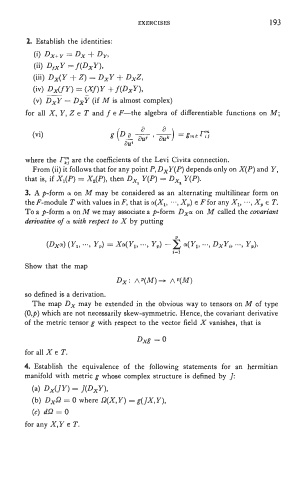
       2.  Establish the identities:
         (i) Dx+y  = DX + DY,
         (ii) D,xY  = f (DxY),
         (iii) Dx(Y + 2) = DxY + DxZ,
         (iv) DfiY)  = (Xf)Y  +f(DxY),
         (v)  D~Y = D~Y (if M is almost complex)
       for  all  X, Y, Z  E T and f E F-the   algebra of  differentiable functions on M;


       where the rg are the coefficients of the Levi Civita connection.
         From (ii) it follows that for any point P, DxY(P) depends only on X(P) and Y,
       that is, if Xl(P) = X,(P),  then Dxl  Y(P) = Dx,  Y(P).
       3.  A p-form  a on M may  be considered as an  alternating multilinear form on
       the F-module T with values in F, that is a(Xl, ..., X,)  E F for any XI, ..., X,  E T.
       To a p-form  a on M we may associate a p-form  Dxa  on  M called the cowariant
       derivative of  a with respect to X  by putting


       Show that the map


       so defined is a derivation.
         The map Dx  may be extended in the obvious way to tensors on M of  type
       (0,~) which are not necessarily skew-symmetric. Hence, the covariant derivative
       of  the metric tensor g with respect to the vector field X  vanishes, that is
                                  DJ& =o
       for all X  E T.
       4.  Establish  the  equivalence  of  the  following  statements  for  an  hermitian
       manifold with  metric g whose complex structure is defined by J:
         (4 WJY) = J(DxY),
         (b)  DxQ  = 0 where Q(X, Y) = g( JX, Y),
         (c)  dl2 = 0
       for any X,Y E T.

