


Page 217 - Curvature and Homology
P. 217
6.1.  HOLOMORPHIC  CURVATURE            199
       are 'sufficiently many' holomorphic pfaffian forms, then (-  l),  x(M) 2 0
       where  X(M) is the Euler  characteristic.  An  example is provided  by  T,
       for which  it is clear that x(T,)  = 0 [8].
         Denote by the pair (M, g) a Kaehler manifold with metricg and under-
       lying  complex  manifold  M.  Consider  the  Kaehler  manifolds  (M, g)
       and (M, g').  If the connections o and o' canonically defined by g and g',
       respectively,  are  projectively  related,  a certain  tensor  w  (the  complex
       analogue  of  the  Weyl  projective  curvature  tensor)  is  an  invariant  of
       these connections. Its vanishing is of interest. For, if w  = 0, the manifold
       (M, g) (or (M, g')) has constant holomorphic curvature. Conversely, for a
       manifold of constant holomorphic curvature, w  = 0. In this way, constant
       holomorphic  curvature is seen to be the complex  analogue  of  constant
       curvature  in  a  Riemannian  manifold  [33].  (A  Kaehler  manifold  of
       constant curvature is of  zero  curvature).  The homological structure of
       elliptic  space  is,  as  previously  mentioned,  identical  with  that  of  P,.
       However, the betti numbers of P, are retained even for deviations from
       projective flatness [7].
         An  important  application  of  the  results  of  Chapter  I11  is  sketched
       in 5 6.14 where the so-called vanishing theorems of Kodaira are obtained.
       These  theorems  are  of  interest  in  the  applications  of  sheaf  theory
       to  complex  manifolds  since  it  is  important  to  know  when  certain
       cohomology groups vanish.

                         6.1.  Holomorphic curvature

         Let M be a Kaehler manifold of constant curvature K whose complex
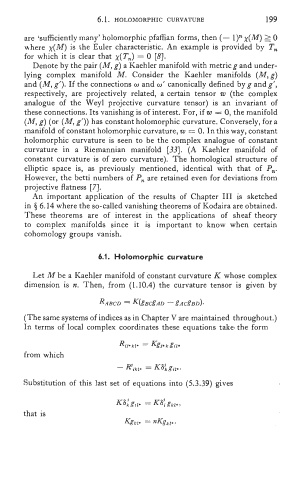
       dimension  is  n.  Then,  from  (1.10.4)  the  curvature tensor  is  given  by


       (The same systems of indices as in Chapter V are maintained throughout.)
       In terms of  local complex  coordinates these equations take* the form


       Substitution of  this  last set of  equations into (5.3.39)  gives

