


Page 728 - Discrete Mathematics and Its Applications
P. 728
10.6 Shortest-Path Problems  707


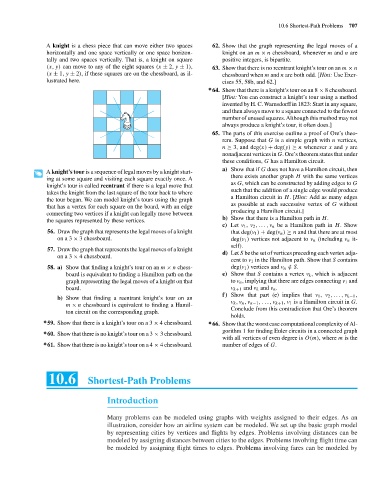
                                 A knight is a chess piece that can move either two spaces  62. Show that the graph representing the legal moves of a
                                 horizontally and one space vertically or one space horizon-  knight on an m × n chessboard, whenever m and n are
                                 tally and two spaces vertically. That is, a knight on square  positive integers, is bipartite.
                                 (x, y) can move to any of the eight squares (x ± 2,y ± 1),  63. Show that there is no reentrant knight’s tour on an m × n
                                 (x ± 1,y ± 2), if these squares are on the chessboard, as il-  chessboard when m and n are both odd. [Hint: Use Exer-
                                 lustrated here.                                         cises 55, 58b, and 62.]
                                                                                    ∗ 64. Show that there is a knight’s tour on an 8 × 8 chessboard.
                                                                                         [Hint: You can construct a knight’s tour using a method
                                                                                         invented by H. C.Warnsdorff in 1823: Start in any square,
                                                                                         and then always move to a square connected to the fewest
                                                                                         number of unused squares.Although this method may not
                                                                                         always produce a knight’s tour, it often does.]
                                                                                      65. The parts of this exercise outline a proof of Ore’s theo-
                                                                                         rem. Suppose that G is a simple graph with n vertices,
                                                                                         n ≥ 3, and deg(x) + deg(y) ≥ n whenever x and y are
                                                                                         nonadjacent vertices in G. Ore’s theorem states that under
                                                                                         these conditions, G has a Hamilton circuit.
                                                                                         a) Show that if G does not have a Hamilton circuit, then
                                 A knight’s tour is a sequence of legal moves by a knight start-
                                 ing at some square and visiting each square exactly once. A  there exists another graph H with the same vertices
                                 knight’s tour is called reentrant if there is a legal move that  as G, which can be constructed by adding edges to G
                                 takes the knight from the last square of the tour back to where  such that the addition of a single edge would produce
                                 the tour began. We can model knight’s tours using the graph  a Hamilton circuit in H.[Hint: Add as many edges
                                                                                            as possible at each successive vertex of G without
                                 that has a vertex for each square on the board, with an edge
                                                                                            producing a Hamilton circuit.]
                                 connecting two vertices if a knight can legally move between
                                                                                         b) Show that there is a Hamilton path in H.
                                 the squares represented by these vertices.
                                                                                         c) Let v 1 , v 2 ,..., v n be a Hamilton path in H. Show
                                  56. Draw the graph that represents the legal moves of a knight  that deg(v 1 ) + deg(v n ) ≥ n and that there are at most
                                     ona3 × 3 chessboard.                                   deg(v 1 ) vertices not adjacent to v n (including v n it-
                                                                                            self).
                                  57. Draw the graph that represents the legal moves of a knight  d) Let S be the set of vertices preceding each vertex adja-
                                     ona3 × 4 chessboard.
                                                                                            cent to v 1 in the Hamilton path. Show that S contains
                                  58. a) Show that finding a knight’s tour on an m × n chess-  deg(v 1 ) vertices and v n /∈ S.
                                        board is equivalent to finding a Hamilton path on the  e) Show that S contains a vertex v k , which is adjacent
                                        graph representing the legal moves of a knight on that  to v n , implying that there are edges connecting v 1 and
                                        board.                                              v k+1 and v k and v n .
                                                                                         f) Show that part (e) implies that v 1 , v 2 ,..., v k−1 ,
                                     b) Show that finding a reentrant knight’s tour on an
                                                                                            v k , v n , v n−1 ,..., v k+1 , v 1 is a Hamilton circuit in G.
                                        m × n chessboard is equivalent to finding a Hamil-
                                                                                            Conclude from this contradiction that Ore’s theorem
                                        ton circuit on the corresponding graph.
                                                                                            holds.
                                ∗ 59. Show that there is a knight’s tour on a 3 × 4 chessboard.  ∗ 66. Show that the worst case computational complexity ofAl-
                                                                                         gorithm 1 for finding Euler circuits in a connected graph
                                ∗ 60. Show that there is no knight’s tour on a 3 × 3 chessboard.
                                                                                         with all vertices of even degree is O(m), where m is the
                                ∗ 61. Show that there is no knight’s tour on a 4 × 4 chessboard.  number of edges of G.


                                  10.6         Shortest-Path Problems


                                                     Introduction


                                                     Many problems can be modeled using graphs with weights assigned to their edges. As an
                                                     illustration, consider how an airline system can be modeled. We set up the basic graph model
                                                     by representing cities by vertices and flights by edges. Problems involving distances can be
                                                     modeled by assigning distances between cities to the edges. Problems involving flight time can
                                                     be modeled by assigning flight times to edges. Problems involving fares can be modeled by

