


Page 44 - Designing Autonomous Mobile Robots : Inside the Mindo f an Intellegent Machine
P. 44
The Basics of Real-time Software (For Mere Mortals)

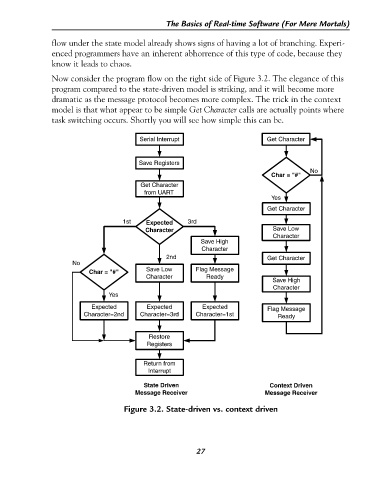
               flow under the state model already shows signs of having a lot of branching. Experi-
               enced programmers have an inherent abhorrence of this type of code, because they
               know it leads to chaos.

               Now consider the program flow on the right side of Figure 3.2. The elegance of this
               program compared to the state-driven model is striking, and it will become more
               dramatic as the message protocol becomes more complex. The trick in the context
               model is that what appear to be simple Get Character calls are actually points where
               task switching occurs. Shortly you will see how simple this can be.


                                        Serial Interrupt                   Get Character


                                        Save Registers
                                                                                       No
                                                                            Char = "#"
                                        Get Character
                                         from UART
                                                                            Yes
                                                                           Get Character
                                   1st    Expected   3rd
                                         Character                           Save Low
                                                                             Character
                                                         Save High
                                                         Character
                                               2nd                         Get Character
                     No
                                          Save Low     Flag Message
                          Char = "#"
                                          Character       Ready
                                                                             Save High
                                                                             Character
                               Yes
                          Expected        Expected       Expected          Flag Message
                        Character=2nd   Character=3rd  Character=1st          Ready


                                          Restore
                                          Registers


                                         Return from
                                          Interrupt
                                         State Driven                       Context Driven
                                       Message Receiver                    Message Receiver
                                   Figure 3.2. State-driven vs. context driven


                                                        27

