


Page 69 - Designing Autonomous Mobile Robots : Inside the Mindo f an Intellegent Machine
P. 69
Chapter 4

                            Nominal
                              PIR
                             Threat
                           Contribution
                           100
                                                                 T1
                                                                           T2

                           80

                              T0
                           60


                           40


                           20

                                                                 Ambient Temperature
                                                                 Degrees Farenheight
                                     20      40     60      80     100    120

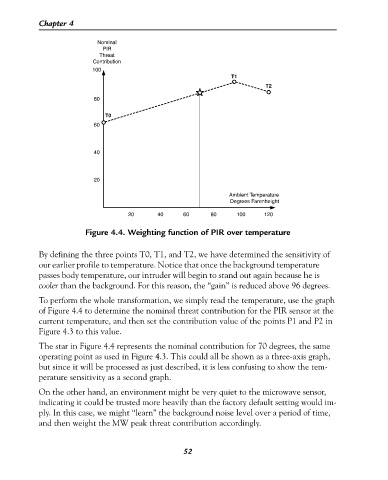
                         Figure 4.4. Weighting function of PIR over temperature


            By defining the three points T0, T1, and T2, we have determined the sensitivity of
            our earlier profile to temperature. Notice that once the background temperature
            passes body temperature, our intruder will begin to stand out again because he is
            cooler than the background. For this reason, the “gain” is reduced above 96 degrees.

            To perform the whole transformation, we simply read the temperature, use the graph
            of Figure 4.4 to determine the nominal threat contribution for the PIR sensor at the
            current temperature, and then set the contribution value of the points P1 and P2 in
            Figure 4.3 to this value.
            The star in Figure 4.4 represents the nominal contribution for 70 degrees, the same
            operating point as used in Figure 4.3. This could all be shown as a three-axis graph,
            but since it will be processed as just described, it is less confusing to show the tem-
            perature sensitivity as a second graph.
            On the other hand, an environment might be very quiet to the microwave sensor,
            indicating it could be trusted more heavily than the factory default setting would im-
            ply. In this case, we might “learn” the background noise level over a period of time,
            and then weight the MW peak threat contribution accordingly.


                                                    52

