


Page 102 - Designing Sociable Robots
P. 102
breazeal-79017  book  March 18, 2002  14:54


                       The Auditory System                                                   83


                       speak to their preverbal infant, their prosodic patterns (the contour of the fundamental
                       frequency and modulations in intensity) are exaggerated in characteristic ways. Even with
                       newborns, mothers use higher mean pitch, wider pitch range, longer pauses, shorter phrases,
                       and more prosodic repetition when addressing infants than when speaking to an adult. These
                       affective contours have been found to exist in several cultures. This exaggerated manner of
                       speaking (i.e., motherese) serves to engage infant’s attention and prolong interaction.
                         Maternal intonation is finely tuned to the behavioral and affective state of the infant.
                       Further, mothers intuitively use selective prosodic contours to express different affective
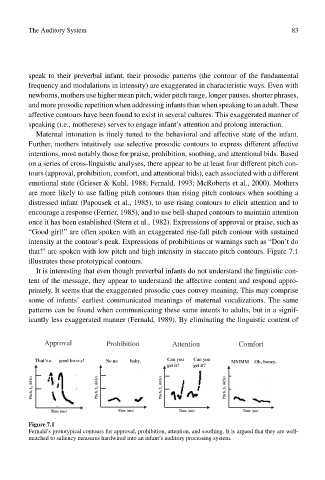
                       intentions, most notably those for praise, prohibition, soothing, and attentional bids. Based
                       on a series of cross-linguistic analyses, there appear to be at least four different pitch con-
                       tours (approval, prohibition, comfort, and attentional bids), each associated with a different
                       emotional state (Grieser & Kuhl, 1988; Fernald, 1993; McRoberts et al., 2000). Mothers
                       are more likely to use falling pitch contours than rising pitch contours when soothing a
                       distressed infant (Papousek et al., 1985), to use rising contours to elicit attention and to
                       encourage a response (Ferrier, 1985), and to use bell-shaped contours to maintain attention
                       once it has been established (Stern et al., 1982). Expressions of approval or praise, such as
                       “Good girl!” are often spoken with an exaggerated rise-fall pitch contour with sustained
                       intensity at the contour’s peak. Expressions of prohibitions or warnings such as “Don’t do
                       that!” are spoken with low pitch and high intensity in staccato pitch contours. Figure 7.1
                       illustrates these prototypical contours.
                         It is interesting that even though preverbal infants do not understand the linguistic con-
                       tent of the message, they appear to understand the affective content and respond appro-
                       priately. It seems that the exaggerated prosodic cues convey meaning. This may comprise
                       some of infants’ earliest communicated meanings of maternal vocalizations. The same
                       patterns can be found when communicating these same intents to adults, but in a signif-
                       icantly less exaggerated manner (Fernald, 1989). By eliminating the linguistic content of

                           Approval        Prohibition       Attention        Comfort

                        That’s a  good bo-o-y!  No no  baby.  Can you  Can you  MMMM  Oh, honey.
                                                           get it?  get it?
                       Pitch, f o (kHz)  Pitch, f o (kHz)  Pitch, f o (kHz)  Pitch, f o (kHz)


                             Time (ms)        Time (ms)        Time (ms)        Time (ms)
                       Figure 7.1
                       Fernald’s prototypical contours for approval, prohibition, attention, and soothing. It is argued that they are well-
                       matched to saliency measures hardwired into an infant’s auditory processing system.

