


Page 346 - E-Bussiness and E-Commerce Management Strategy, Implementation, and Practice
P. 346
M05_CHAF9601_04_SE_C05.QXD:D01_CHAF7409_04_SE_C01.QXD  16/4/09  11:12  Page 313


                                                                                 Chapter 5 E-business strategy  313


                     Strategy implementation


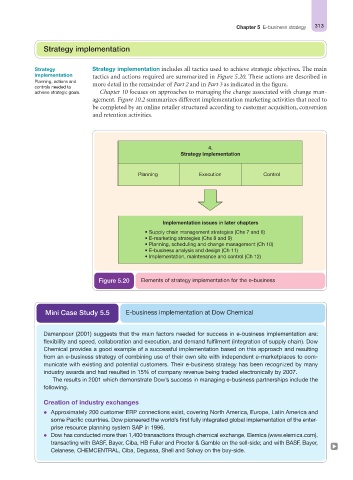
                  Strategy          Strategy implementation includes all tactics used to achieve strategic objectives. The main
                  implementation    tactics and actions required are summarized in Figure 5.20. These actions are described in
                  Planning, actions and
                  controls needed to  more detail in the remainder of Part 2 and in Part 3 as indicated in the figure.
                  achieve strategic goals.  Chapter 10 focuses on approaches to managing the change associated with change man-
                                    agement. Figure 10.2 summarizes different implementation marketing activities that need to
                                    be completed by an online retailer structured according to customer acquisition, conversion
                                    and retention activities.


                                                                        4.
                                                                Strategy implementation


                                                  Planning           Execution            Control


                                                          Implementation issues in later chapters
                                                    • Supply chain management strategies (Chs 7 and 8)
                                                    • E-marketing strategies (Chs 8 and 9)
                                                    • Planning, scheduling and change management (Ch 10)
                                                    • E-business analysis and design (Ch 11)
                                                    • Implementation, maintenance and control (Ch 12)


                                      Figure 5.20  Elements of strategy implementation for the e-business


                     Mini Case Study 5.5      E-business implementation at Dow Chemical


                     Damanpour (2001) suggests that the main factors needed for success in e-business implementation are:
                     flexibility and speed, collaboration and execution, and demand fulfilment (integration of supply chain). Dow
                     Chemical provides a good example of a successful implementation based on this approach and resulting
                     from an e-business strategy of combining use of their own site with independent e-marketplaces to com-
                     municate with existing and potential customers. Their e-business strategy has been recognized by many
                     industry awards and had resulted in 15% of company revenue being traded electronically by 2007.
                       The results in 2001 which demonstrate Dow’s success in managing e-business partnerships include the
                     following.

                     Creation of industry exchanges
                       Approximately 200 customer ERP connections exist, covering North America, Europe, Latin America and
                       some Pacific countries. Dow pioneered the world’s first fully integrated global implementation of the enter-
                       prise resource planning system SAP in 1996.
                       Dow has conducted more than 1,400 transactions through chemical exchange, Elemica (www.elemica.com),
                       transacting with BASF, Bayer, Ciba, HB Fuller and Procter & Gamble on the sell-side; and with BASF, Bayer,
                       Celanese, CHEMCENTRAL, Ciba, Degussa, Shell and Solvay on the buy-side.

