


Page 120 - Educating the Engineer of 2020: Adapting Engineering Education to the New Century
P. 120
Educating the Engineer of 2020:  Adapting Engineering Education to the New Century
  http://www.nap.edu/catalog/11338.html


             DESIGNING FROM A BLANK SLATE                             103

             needs in engineering education. In addition, consultants were brought
             to campus to discuss specific topics, and the results of the NSF coalition
             programs were reviewed in detail. The data were then compiled and
             discussed in a series of faculty meetings and off-campus retreats. With
             the arrival of the student partners, various teaching and learning con-
             cepts developed during the previous year were tested with “real” fresh-
             man-age students.
                 Several of the principles that emerged have stood the test of time
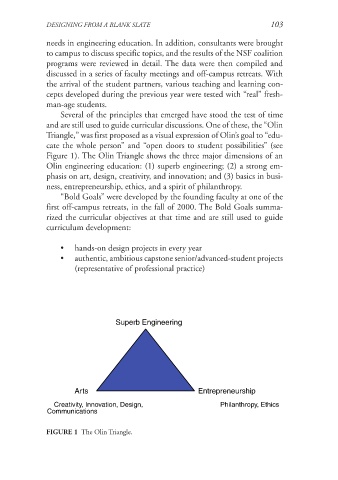
             and are still used to guide curricular discussions. One of these, the “Olin
             Triangle,” was first proposed as a visual expression of Olin’s goal to “edu-
             cate the whole person” and “open doors to student possibilities” (see
             Figure 1). The Olin Triangle shows the three major dimensions of an
             Olin engineering education: (1) superb engineering; (2) a strong em-
             phasis on art, design, creativity, and innovation; and (3) basics in busi-
             ness, entrepreneurship, ethics, and a spirit of philanthropy.
                 “Bold Goals” were developed by the founding faculty at one of the
             first off-campus retreats, in the fall of 2000. The Bold Goals summa-
             rized the curricular objectives at that time and are still used to guide
             curriculum development:

                 •  hands-on design projects in every year
                 •  authentic, ambitious capstone senior/advanced-student projects
                    (representative of professional practice)


                               Superb Engineering


                    Arts                           Entrepreneurship
               Creativity, Innovation, Design,                                         Philanthropy, Ethics
             Communications

             FIGURE 1 The Olin Triangle.


                      Copyright © National Academy of Sciences. All rights reserved.

