


Page 238 - Electrical Installation in Hazardous Area
P. 238
202  Electrical installations in hazardous areas

                                       A


                                   B
                                                                  -


                                                               Detail of rear inner
                                                              corner of compression
                                                                   element
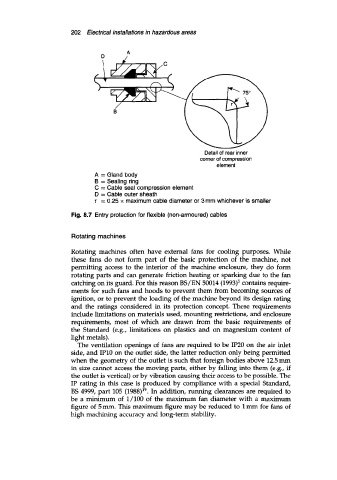
                              A  = Gland body
                              B = Sealing ring
                              C = Cable seal compression element
                              D = Cable outer sheath
                              r  = 0.25 x maximum cable diameter or 3mm whichever is smaller

                       Fig. 8.7  Entry protection for flexible (non-armoured) cables


                       Rotating machines

                       Rotating machines often have  external fans for  cooling purposes. While
                       these  fans do not  form part  of  the basic protection  of  the machine,  not
                       permitting access to the interior of  the machine enclosure, they  do form
                       rotating parts and can generate friction heating or sparking due to the fan
                       catching on its guard. For this reason BS/EN 50014 (1993)' contains require-
                       ments for such fans and hoods to prevent them from becoming sources of
                       ignition, or to prevent the loading of  the machine beyond its design rating
                       and the ratings considered in its protection concept. These requirements
                       include limitations on materials used, mounting restrictions, and enclosure
                       requirements,  most  of  which are  drawn  from  the basic  requirements of
                       the  Standard (e.g., limitations on plastics and  on magnesium content of
                       light metals).
                         The ventilation openings of  fans are required to be IP20 on the air inlet
                       side, and IPlO on the outlet side, the latter reduction only being permitted
                       when the geometry of  the outlet is such that foreign bodies above 12.5mm
                       in size cannot access the moving parts, either by falling into them (e.g., if
                       the outlet is vertical) or by vibration causing their access to be possible. The
                       IP rating in this case is produced by compliance with a special Standard,
                       BS 4999,  part 105 (1988)19. In addition, running clearances are required to
                       be a minimum of  1/100 of  the maximum fan diameter with a maximum
                       figure of  5mm. This maximum figure may be reduced to 1 mm for fans of
                       high machining accuracy and long-term stability.

