


Page 194 - Encyclopedia of Chemical Compounds 3 Vols
P. 194
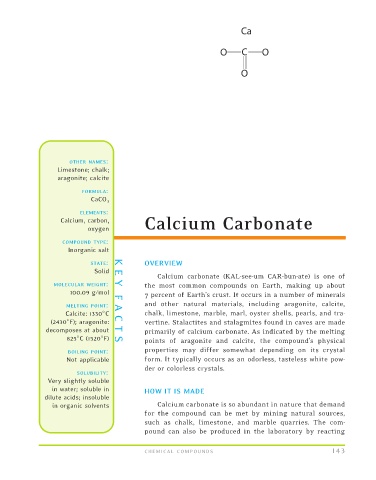
Ca

                                                              O     C     O


                                                                    O


                    OTHER NAMES:
                 Limestone; chalk;
                 aragonite; calcite

                        FORMULA:
                          CaCO 3
                       ELEMENTS:
                  Calcium, carbon,       Calcium Carbonate
                         oxygen
                  COMPOUND TYPE:
                    Inorganic salt
                          STATE:         OVERVIEW
                           Solid  KE
                                             Calcium carbonate (KAL-see-um CAR-bun-ate) is one of
                MOLECULAR WEIGHT:  Y     the most common compounds on Earth, making up about
                                         7 percent of Earth’s crust. It occurs in a number of minerals
                    100.09 g/mol F
                   MELTING POINT:  A     and other natural materials, including aragonite, calcite,
                                         chalk, limestone, marble, marl, oyster shells, pearls, and tra-

               (2430 F); aragonite:      vertine. Stalactites and stalagmites found in caves are made
                   Calcite: 1330 C C
              decomposes at about  T     primarily of calcium carbonate. As indicated by the melting

                   825 C (1520 F)  S     points of aragonite and calcite, the compound’s physical
                    BOILING POINT:       properties may differ somewhat depending on its crystal
                   Not applicable        form. It typically occurs as an odorless, tasteless white pow-
                                         der or colorless crystals.
                      SOLUBILITY:
              Very slightly soluble
               in water; soluble in      HOW IT IS MADE
             dilute acids; insoluble
               in organic solvents           Calcium carbonate is so abundant in nature that demand
                                         for the compound can be met by mining natural sources,
                                         such as chalk, limestone, and marble quarries. The com-
                                         pound can also be produced in the laboratory by reacting


                                         CHEMICAL COMPOUNDS                                  143

