


Page 125 - Academic Press Encyclopedia of Physical Science and Technology 3rd BioChemistry
P. 125
P1: GMY/GlQ/GLT  P2: GRB Final Pages
 Encyclopedia of Physical Science and Technology  en010k-502  July 16, 2001  16:56


              Nucleic Acid Synthesis                                                                      863

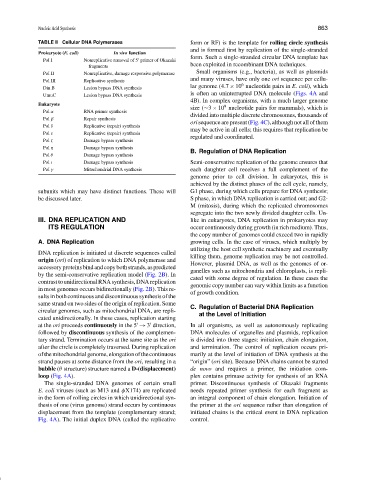
              TABLE II Cellular DNA Polymerases                 form or RF) is the template for rolling circle synthesis
                                                                and is formed first by replication of the single-stranded
              Prokaryote (E. coli)     In vivo function
                                                                form. Such a single-stranded circular DNA template has

               Pol I         Nonreplicative removal of 5 primer of Okazaki
                              fragments                         been exploited in recombinant DNA techniques.
                                                                  Small organisms (e.g., bacteria), as well as plasmids
               Pol II        Nonreplicative, damage responsive polymerase
                                                                and many viruses, have only one ori sequence per cellu-
               Pol III       Replicative synthesis
                                                                                 6
                                                                lar genome (4.7 × 10 nucleotide pairs in E. coli), which
               Din B         Lesion bypass DNA synthesis
                                                                is often an uninterrupted DNA molecule (Figs. 4A and
               UmuC          Lesion bypass DNA synthesis
                                                                4B). In complex organisms, with a much larger genome
              Eukaryote
                                                                           9
                                                                size (∼3 × 10 nucleotide pairs for mammals), which is
               Pol α         RNA primer synthesis
                                                                divided into multiple discrete chromosomes, thousands of
               Pol β         Repair synthesis
                                                                ori sequence are present (Fig. 4C), although not all of them
               Pol δ         Replicative (repair) synthesis
                                                                may be active in all cells; this requires that replication be
               Pol ε         Replicative (repair) synthesis
                                                                regulated and coordinated.
               Pol ζ         Damage bypass synthesis
               Pol η         Damage bypass synthesis
                                                                B. Regulation of DNA Replication
               Pol θ         Damage bypass synthesis
               Pol ι         Damage bypass synthesis            Semi-conservative replication of the genome ensures that
               Pol γ         Mitochondrial DNA synthesis        each daughter cell receives a full complement of the
                                                                genome prior to cell division. In eukaryotes, this is
                                                                achieved by the distinct phases of the cell cycle, namely,
              subunits which may have distinct functions. These will  G1 phase, during which cells prepare for DNA synthesis;
              be discussed later.                               S phase, in which DNA replication is carried out; and G2-
                                                                M (mitosis), during which the replicated chromosomes
                                                                segregate into the two newly divided daughter cells. Un-
              III. DNA REPLICATION AND                          like in eukaryotes, DNA replication in prokaryotes may
                 ITS REGULATION                                 occur continuously during growth (in rich medium). Thus,
                                                                the copy number of genomes could exceed two in rapidly
              A. DNA Replication                                growing cells. In the case of viruses, which multiply by
                                                                utilizing the host cell synthetic machinery and eventually
              DNA replication is initiated at discrete sequences called
                                                                killing them, genome replication may be not controlled.
              origin (ori) of replication to which DNA polymerase and
                                                                However, plasmid DNA, as well as the genomes of or-
              accessoryproteinsbindandcopybothstrands,aspredicted
                                                                ganelles such as mitochondria and chloroplasts, is repli-
              by the semi-conservative replication model (Fig. 2B). In
                                                                cated with some degree of regulation. In these cases the
              contrasttounidirectional RNA synthesis, DNA replication
                                                                genomic copy number can vary within limits as a function
              in most genomes occurs bidirectionally (Fig. 2B). This re-
                                                                of growth condition.
              sults in both continuous and discontinuous synthesis of the
              same strand on two sides of the origin of replication. Some
                                                                C. Regulation of Bacterial DNA Replication
              circular genomes, such as mitochondrial DNA, are repli-
                                                                   at the Level of Initiation
              cated unidirectionally. In these cases, replication starting

              at the ori proceeds continuously in the 5 → 3 direction,  In all organisms, as well as autonomously replicating

              followed by discontinuous synthesis of the complemen-  DNA molecules of organelles and plasmids, replication
              tary strand. Termination occurs at the same site as the ori  is divided into three stages: initiation, chain elongation,
              after the circle is completely traversed. During replication  and termination. The control of replication occurs pri-
              of the mitochondrial genome, elongation of the continuous  marily at the level of initiation of DNA synthesis at the
              strand pauses at some distance from the ori, resulting in a  “origin” (ori site). Because DNA chains cannot be started
              bubble (θ structure) structure named a D-(displacement)  de novo and requires a primer, the initiation com-
              loop (Fig. 4A).                                   plex contains primase activity for synthesis of an RNA
                The single-stranded DNA genomes of certain small  primer. Discontinuous synthesis of Okazaki fragments
              E. coli viruses (such as M13 and φX174) are replicated  needs repeated primer synthesis for each fragment as
              in the form of rolling circles in which unidirectional syn-  an integral component of chain elongation. Initiation of
              thesis of one (virus genome) strand occurs by continuous  the primer at the ori sequence rather than elongation of
              displacement from the template (complementary strand;  initiated chains is the critical event in DNA replication
              Fig. 4A). The initial duplex DNA (called the replicative  control.

