


Page 160 - Engineering Plastics Handbook
P. 160
Polybutylene Terephthalate (PBT)  133
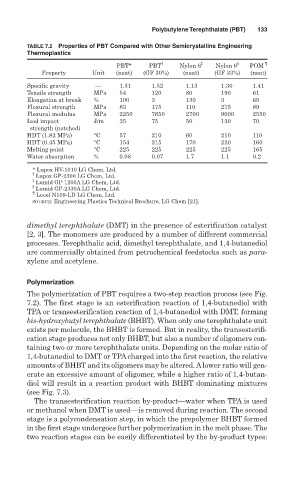
        TABLE 7.2 Properties of PBT Compared with Other Semicrystalline Engineering
        Thermoplastics

                                PBT*     PBT †   Nylon 6 ‡  Nylon 6 §  POM  ¶
            Property      Unit  (neat)  (GF 30%)  (neat)   (GF 33%)  (neat)
        Specific gravity   —     1.31     1.52     1.13      1.30    1.41
        Tensile strength  MPa    54       120      80        190     61
        Elongation at break  %   100      3        130       3       65
        Flexural strength  MPa   83       175      110       275     89
        Flexural modulus  MPa    2250     7650     2700      9000    2550
        Izod impact       J/m    35       75       50        130     70
         strength (notched)
        HDT (1.82 MPa)    °C     57       210      60        210     110
        HDT (0.45 MPa)    °C     154      215      170       220     160
        Melting point     °C     225      225      225       225     165
        Water absorption  %      0.08     0.07     1.7       1.1     0.2
          * Lupox HV-1010 LG Chem, Ltd.
          †
           Lupox GP-2300 LG Chem, Ltd.
          ‡
           Lumid GP-1200A LG Chem, Ltd.
          §
           Lumid GP-2330A LG Chem, Ltd.
          ¶
           Lucel N109-LD LG Chem, Ltd.
          SOURCE: Engineering Plastics Technical Brochure, LG Chem [21].
        dimethyl terephthalate (DMT) in the presence of esterification catalyst
        [2, 3]. The monomers are produced by a number of different commercial
        processes. Terephthalic acid, dimethyl terephthalate, and 1,4-butanediol
        are commercially obtained from petrochemical feedstocks such as para-
        xylene and acetylene.


        Polymerization
        The polymerization of PBT requires a two-step reaction process (see Fig.
        7.2). The first stage is an esterification reaction of 1,4-butanediol with
        TPA or transesterification reaction of 1,4-butanediol with DMT, forming
        bis-hydroxybutyl terephthalate (BHBT). When only one terephthalate unit
        exists per molecule, the BHBT is formed. But in reality, the transesterifi-
        cation stage produces not only BHBT, but also a number of oligomers con-
        taining two or more terephthalate units. Depending on the molar ratio of
        1,4-butanediol to DMT or TPA charged into the first reaction, the relative
        amounts of BHBT and its oligomers may be altered. Alower ratio will gen-
        erate an excessive amount of oligomer, while a higher ratio of 1,4-butan-
        diol will result in a reaction product with BHBT dominating mixtures
        (see Fig. 7.3).
          The transesterification reaction by-product—water when TPA is used
        or methanol when DMT is used––is removed during reaction. The second
        stage is a polycondensation step, in which the prepolymer BHBT formed
        in the first stage undergoes further polymerization in the melt phase. The
        two reaction stages can be easily differentiated by the by-product types:

