


Page 602 - Fair, Geyer, and Okun's Water and wastewater engineering : water supply and wastewater removal
P. 602
JWCL344_ch15_555-589.qxd  8/7/10  9:03 PM  Page 558


                    558  Chapter 15  Sewerage Systems: Modeling and Computer Applications
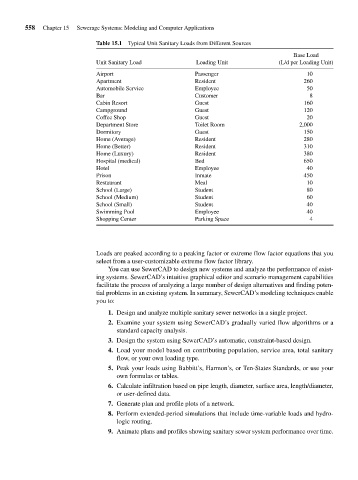
                                         Table 15.1  Typical Unit Sanitary Loads from Different Sources

                                                                                                     Base Load
                                         Unit Sanitary Load             Loading Unit             (L/d per Loading Unit)
                                         Airport                       Passenger                         10
                                         Apartment                     Resident                         260
                                         Automobile Service            Employee                          50
                                         Bar                           Customer                           8
                                         Cabin Resort                  Guest                            160
                                         Campground                    Guest                            120
                                         Coffee Shop                   Guest                             20
                                         Department Store              Toilet Room                     2,000
                                         Dormitory                     Guest                            150
                                         Home (Average)                Resident                         280
                                         Home (Better)                 Resident                         310
                                         Home (Luxury)                 Resident                         380
                                         Hospital (medical)            Bed                              650
                                         Hotel                         Employee                          40
                                         Prison                        Inmate                           450
                                         Restaurant                    Meal                              10
                                         School (Large)                Student                           80
                                         School (Medium)               Student                           60
                                         School (Small)                Student                           40
                                         Swimming Pool                 Employee                          40
                                         Shopping Center               Parking Space                      4


                                         Loads are peaked according to a peaking factor or extreme flow factor equations that you
                                         select from a user-customizable extreme flow factor library.
                                             You can use SewerCAD to design new systems and analyze the performance of exist-
                                         ing systems. SewerCAD’s intuitive graphical editor and scenario management capabilities
                                         facilitate the process of analyzing a large number of design alternatives and finding poten-
                                         tial problems in an existing system. In summary, SewerCAD’s modeling techniques enable
                                         you to:

                                             1. Design and analyze multiple sanitary sewer networks in a single project.
                                             2. Examine your system using SewerCAD’s gradually varied flow algorithms or a
                                                standard capacity analysis.
                                             3. Design the system using SewerCAD’s automatic, constraint-based design.
                                             4. Load your model based on contributing population, service area, total sanitary
                                                flow, or your own loading type.
                                             5. Peak your loads using Babbitt’s, Harmon’s, or Ten-States Standards, or use your
                                                own formulas or tables.
                                             6. Calculate infiltration based on pipe length, diameter, surface area, length/diameter,
                                                or user-defined data.
                                             7. Generate plan and profile plots of a network.
                                             8. Perform extended-period simulations that include time-variable loads and hydro-
                                                logic routing.
                                             9. Animate plans and profiles showing sanitary sewer system performance over time.

