


Page 161 - Fluid Power Engineering
P. 161
Hydraulic Pumps      135


               flow rate, Q , the increase in the oil power, ΔN, the pump outlet power, N ,
                        t                                              out
               and the driving torque, T , if the inlet pressure is 100 kPa.
                                  t
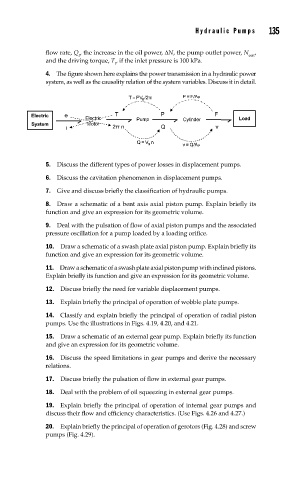
               4.  The figure shown here explains the power transmission in a hydraulic power
               system, as well as the causality relation of the system variables. Discuss it in detail.


               5.  Discuss the different types of power losses in displacement pumps.
               6.  Discuss the cavitation phenomenon in displacement pumps.
               7.  Give and discuss briefly the classification of hydraulic pumps.

               8.  Draw a schematic of a bent axis axial piston pump. Explain briefly its
               function and give an expression for its geometric volume.
               9.  Deal with the pulsation of flow of axial piston pumps and the associated
               pressure oscillation for a pump loaded by a loading orifice.
               10.  Draw a schematic of a swash plate axial piston pump. Explain briefly its
               function and give an expression for its geometric volume.

               11.  Draw a schematic of a swash plate axial piston pump with inclined pistons.
               Explain briefly its function and give an expression for its geometric volume.
               12.  Discuss briefly the need for variable displacement pumps.

               13.  Explain briefly the principal of operation of wobble plate pumps.
               14.  Classify and explain briefly the principal of operation of radial piston
               pumps. Use the illustrations in Figs. 4.19, 4.20, and 4.21.
               15.  Draw a schematic of an external gear pump. Explain briefly its function
               and give an expression for its geometric volume.
               16.  Discuss the speed limitations in gear pumps and derive the necessary
               relations.

               17.  Discuss briefly the pulsation of flow in external gear pumps.
               18.  Deal with the problem of oil squeezing in external gear pumps.
               19.  Explain briefly the principal of operation of internal gear pumps and
               discuss their flow and efficiency characteristics. (Use Figs. 4.26 and 4.27.)

               20.  Explain briefly the principal of operation of gerotors (Fig. 4.28) and screw
               pumps (Fig. 4.29).

