


Page 144 - Fluid Catalytic Cracking Handbook
P. 144
FCC Catalysts    119

  There are three common methods for SO X abatement. These are flue
 gas scrubbing, feedstock desulfurization, and SO X additive. The SO X
 additive is often the least costly alternative, which is the approach
 practiced by many refiners.
  The SO X additive, usually a metal oxide, is added directly to the
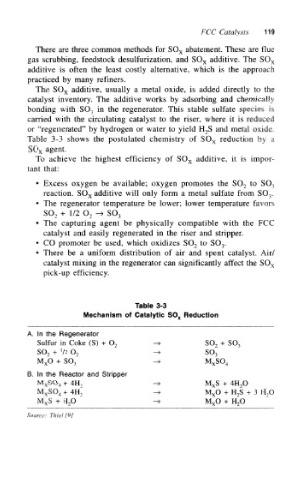
 catalyst inventory. The additive works by adsorbing and chemically
 bonding with SO 3 in the regenerator. This stable sulfate species is
 carried with the circulating catalyst to the riser, where it is reduced
 or "regenerated" by hydrogen or water to yield H 2S and metal oxide.
 Table 3-3 shows the postulated chemistry of SO X reduction by a
 SO X agent.
  To achieve the highest efficiency of SO X additive, it is impor-
 tant that:
  * Excess oxygen be available; oxygen promotes the SO 2 to SO 3
    reaction. SO X additive will only form a metal sulfate from SO V
  * The regenerator temperature be lower; lower temperature favors
    SO 2 + 1/2 O 2 -> SO 3
  * The capturing agent be physically compatible with the FCC
    catalyst and easily regenerated in the riser and stripper.
  * CO promoter be used, which oxidizes SO 2 to SO 3.
  * There be a uniform distribution of air and spent catalyst. Air/

    catalyst mixing in the regenerator can significantly affect the SO X
    pick-up efficiency.


                            Table 3-3
              Mechanism of Catalytic SO X Reduction

 A. In the Regenerator
                                 — »
  Sulfur in Coke (S) + O 2                    SO 2 + SO 3
        l
  SO 2 + /2 O 2                  —>           SO  3
  M XO + SO,                     — >          M XSO 4
 B. In the Reactor and Stripper
                                 — >          M XS + 4H 2O
  M XSO 4 + 4H 2
  M so  + 4H 2                   ->           M XO + H 2S + 3 H 2O
    x
       4
  M XS + H 2O                    —>           M XO + H 2O
 Source: Thiel [9]

