


Page 190 - Fluid Catalytic Cracking Handbook
P. 190
162   Fluid Catalytic Cracking Handbook

 VIII. Energy required to heat the spent catalyst from its reactor to the
     regenerator temperature =
                                                            6
     481.9 - 108.0 - 39.5 - 4.4 - 3.7 - 2.6 - 19.3 = 304.4 x 10  Btti/hr
  IX. Calculation of catalyst circulation

                                       6
     ^ , „. . .                304.4 xl0 Btu/hr
     Catalyst Circulation =
                        (0.285 Btu/°F-lb) x (1,309 - 972)°F
                                6
                      = 3.169 x 10  Ibs/hr = 26.4 short tons/min.

     Where: 0.285 is the catalyst heat capacity (see Figure 5-6)
                            6
     Cat/oil ratio = 3.169 x 10 /658,914 = 4.8
      .„ ,   Coke Yield, wt% 4.2  A 0_ „
     ACoke =               = — = 0.87 wt%
               cat/oil ratio  4,8


 Reactor Heat Balance

  The hot regenerated catalyst supplies the bulk of the heat required
 to vaporize the liquid feed (and any recycle) to provide the overall
 endothermic heat of cracking, and to raise the temperature of disper-
 sion steam and inert gases to the reactor temperature.

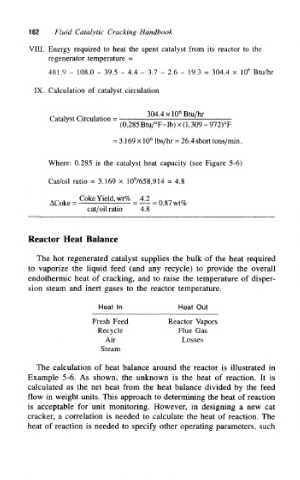
                  Heat In              Heat Out

                 Fresh Feed         Reactor Vapors
                  Recycle              Flue Gas
                    Air                 Losses
                   Steam

  The calculation of heat balance around the reactor is illustrated in
 Example 5-6. As shown, the unknown is the heat of reaction. It is
 calculated as the net heat from the heat balance divided by the feed
 flow in weight units. This approach to determining the heat of reaction
 is acceptable for unit monitoring. However, in designing a new cat
 cracker, a correlation is needed to calculate the heat of reaction. The
 heat of reaction is needed to specify other operating parameters, such

