


Page 145 - Instant notes
P. 145
E4
                             ELECTROCHEMICAL
                             THERMODYNAMICS


        Key Notes
                                A common notation is used for electrochemical cells. The
                                symbols |, || and  are used to denote a phase boundary, salt bridge
                                and liquid junction respectively. All outside electrical
                                connections are assumed to be present and activities (or
                                concentrations) and fugacities (or pressures) are specified where
                                necessary. The left hand (LH) half-cell is shown on the left-hand
                                side of the diagram with the right-hand (RH) half-cell on the
                                right-hand side. The cell voltage is the potential difference
                                between RH and LH half-cells when a salt bridge is used.
                                The formal cell reaction is obtained by taking the difference
                                between the RH and LH half-cell reduction reactions, whilst
                                ensuring that the same number of electrons is present in each
                                half-cell reaction.
                                Changes in half-cell potential can be measured by measuring the
                                voltage of a cell with the half-cell as the RH electrode and a
                                reference electrode as the LH electrode. This is because the
                                reference electrode maintains a constant half-cell potential even
                                with small changes in reagent activity.
                                The standard reduction potential of a half-cell is the standard cell
                                potential of a cell with the half-cell as the RH electrode and the
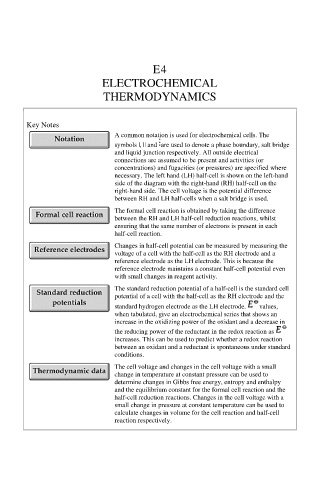
                                standard hydrogen electrode as the LH electrode.   values,
                                when tabulated, give an electrochemical series that shows an
                                increase in the oxidizing power of the oxidant and a decrease in
                                the reducing power of the reductant in the redox reaction as
                                increases. This can be used to predict whether a redox reaction
                                between an oxidant and a reductant is spontaneous under standard
                                conditions.
                                The cell voltage and changes in the cell voltage with a small
                                change in temperature at constant pressure can be used to
                                determine changes in Gibbs free energy, entropy and enthalpy
                                and the equilibrium constant for the formal cell reaction and the
                                half-cell reduction reactions. Changes in the cell voltage with a
                                small change in pressure at constant temperature can be used to
                                calculate changes in volume for the cell reaction and half-cell
                                reaction respectively.

