


Page 544 - Forensic Structural Engineering Handbook
P. 544
14.34             MATERIAL-SPECIFIC FORENSIC ANALYSES

             Compressive buckling of the unrestrained arch, due to inadequate bracing, is considered
           to be the sole cause of failure. Arches ahead of the decking/diaphragm placement had
           inadequate or nonexistent lateral bracing. The rapid collapse also suggests buckling,
           whereas flexural failure is usually accompanied by noise and incremental movements over
           a period of time. The arena was rebuilt per the original design.


           Case Study 7. Port Hadlock Post Office, Port Hadlock, Washington

           This case study illustrates eccentric connection, truss bracing, and buckling. When light-
           framed timber trusses collapse under construction, it is usually the result of insufficient
           bracing. That was considered the cause by the truss company’s representatives. In this case
           the bracing did not quite meet the specified criteria of the truss company, thus giving them
           a significant legal advantage. However, the author determined it was not the primary cause
           of collapse and probably would not have prevented the collapse of the trusses had the spec-
           ified bracing criteria been fully met.
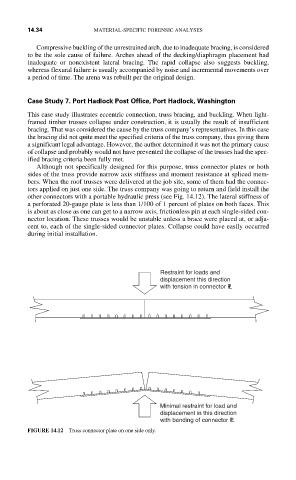
             Although not specifically designed for this purpose, truss connector plates or both
           sides of the truss provide narrow axis stiffness and moment resistance at spliced mem-
           bers. When the roof trusses were delivered at the job site, some of them had the connec-
           tors applied on just one side. The truss company was going to return and field install the
           other connectors with a portable hydraulic press (see Fig. 14.12). The lateral stiffness of
           a perforated 20-gauge plate is less than 1/100 of 1 percent of plates on both faces. This
           is about as close as one can get to a narrow axis, frictionless pin at each single-sided con-
           nector location. These trusses would be unstable unless a brace were placed at, or adja-
           cent to, each of the single-sided connector plates. Collapse could have easily occurred
           during initial installation.


                                              Restraint for loads and
                                              displacement this direction
                                              with tension in connector PL


                                              Minimal restraint for load and
                                              displacement in this direction
                                              with bending of connector PL
           FIGURE 14.12  Truss connector plate on one side only.

