


Page 252 - Fundamentals of Geomorphology
P. 252
FLUVIAL LANDSCAPES 235


                   ( ) Ripples (F   1)                   ( ) Dunes with superimposed ripples (F   1)
                                                         b
                   a
                                                              Weak boil


                                 coefficient
                          roughness
                    Manning roughness coefficient
                    Manning
                    0.017–0.028
                    0.017–0.028
                   ( ) Dunes (F  1)                      ( ) Washed-out dunes (F  1)
                                                         d
                   c
                          Boil
                          Boil
                    0.018–0.035
                    0.018–0.035
                                                         f
                   e
                   ( ) Plane bed (F  1)                  ( ) Standing wave antidunes (F  1)


                    0.011–0.015
                                                          0.012–0.016
                    0.011–0.015                           0.012–0.016
                   () Antidunes (F  1)                   () Chute and pool (F  1)
                                                         h
                   g
                   Incipient breaking wave                                Breaking antidune wave
                                                           Accelerating flow

                    0.012
                    0.012 – 0.020
                         0.020
                        –
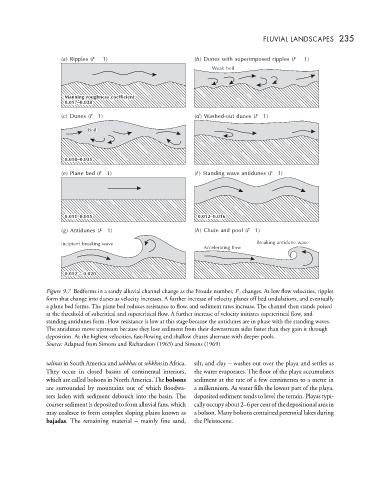
              Figure 9.7 Bedforms in a sandy alluvial channel change as the Froude number, F, changes. At low flow velocities, ripples
              form that change into dunes as velocity increases. A further increase of velocity planes off bed undulations, and eventually
              a plane bed forms. The plane bed reduces resistance to flow, and sediment rates increase. The channel then stands poised
              at the threshold of subcritical and supercritical flow. A further increase of velocity initiates supercritical flow, and
              standing antidunes form. Flow resistance is low at this stage because the antidunes are in phase with the standing waves.
              The antidunes move upstream because they lose sediment from their downstream sides faster than they gain it through
              deposition. At the highest velocities, fast-flowing and shallow chutes alternate with deeper pools.
              Source: Adapted from Simons and Richardson (1963) and Simons (1969)

              salinas in South America and sabkhas or sebkhas in Africa.  silt, and clay – washes out over the playa and settles as
              They occur in closed basins of continental interiors,  the water evaporates. The floor of the playa accumulates
              which are called bolsons in North America. The bolsons  sediment at the rate of a few centimetres to a metre in
              are surrounded by mountains out of which floodwa-  a millennium. As water fills the lowest part of the playa,
              ters laden with sediment debouch into the basin. The  deposited sediment tends to level the terrain. Playas typi-
              coarser sediment is deposited to form alluvial fans, which  callyoccupyabout2–6percentofthedepositionalareain
              may coalesce to form complex sloping plains known as  a bolson. Many bolsons contained perennial lakes during
              bajadas. The remaining material – mainly fine sand,  the Pleistocene.

