


Page 243 - gas transport in porous media
P. 243
239
                           Chapter 13: Lattice Boltzmann Method
                           equation, with particle tracking to determine the dispersion in that flow field. The
                           aperture field between the two plates was determined by filling the gap with a constant
                           concentration of dye.
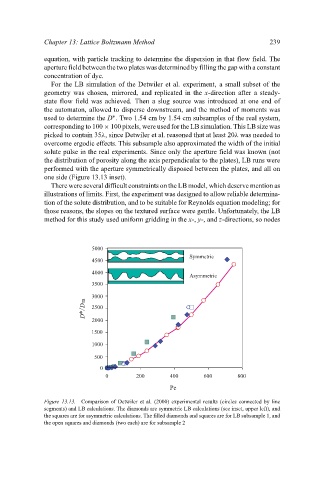
                             For the LB simulation of the Detwiler et al. experiment, a small subset of the
                           geometry was chosen, mirrored, and replicated in the x-direction after a steady-
                           state flow field was achieved. Then a slug source was introduced at one end of
                           the automaton, allowed to disperse downstream, and the method of moments was
                                               ∗
                           used to determine the D . Two 1.54 cm by 1.54 cm subsamples of the real system,
                           corresponding to 100 × 100 pixels, were used for the LB simulation. This LB size was
                           picked to contain 35λ, since Detwiler et al. reasoned that at least 20λ was needed to
                           overcome ergodic effects. This subsample also approximated the width of the initial
                           solute pulse in the real experiments. Since only the aperture field was known (not
                           the distribution of porosity along the axis perpendicular to the plates), LB runs were
                           performed with the aperture symmetrically disposed between the plates, and all on
                           one side (Figure 13.13 inset).
                             There were several difficult constraints on the LB model, which deserve mention as
                           illustrations of limits. First, the experiment was designed to allow reliable determina-
                           tion of the solute distribution, and to be suitable for Reynolds equation modeling; for
                           those reasons, the slopes on the textured surface were gentle. Unfortunately, the LB
                           method for this study used uniform gridding in the x-, y-, and z-directions, so nodes


                                         5000
                                                                    Symmetric
                                         4500
                                         4000
                                                                    Asymmetric
                                         3500

                                         3000
                                       D*/Dm  2500

                                         2000
                                         1500
                                         1000
                                         500
                                           0
                                             0       200       400      600       800
                                                               Pe
                           Figure 13.13.  Comparison of Detwiler et al. (2000) experimental results (circles connected by line
                           segments) and LB calculations. The diamonds are symmetric LB calculations (see inset, upper left), and
                           the squares are for asymmetric calculations. The filled diamonds and squares are for LB subsample 1, and
                           the open squares and diamonds (two each) are for subsample 2

