


Page 519 - Handbook Of Integral Equations
P. 519
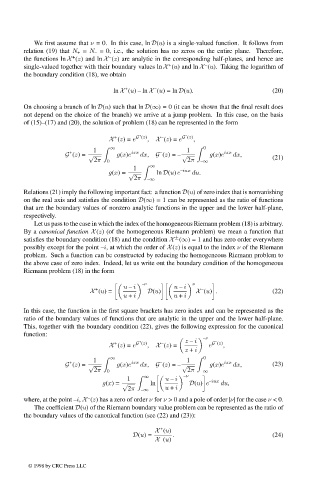
We first assume that ν = 0. In this case, ln D(u) is a single-valued function. It follows from
               relation (19) that N + = N – = 0, i.e., the solution has no zeros on the entire plane. Therefore,
                                         –
                              +
               the functions ln X (z) and ln X (z) are analytic in the corresponding half-planes, and hence are
                                                                      –
                                                           +
               single-valued together with their boundary values ln X (u) and ln X (u). Taking the logarithm of
               the boundary condition (18), we obtain
                                                       –
                                              +
                                           ln X (u) – ln X (u)=ln D(u).                    (20)
               On choosing a branch of ln D(u) such that ln D(∞) = 0 (it can be shown that the final result does
               not depend on the choice of the branch) we arrive at a jump problem. In this case, on the basis
               of (15)–(17) and (20), the solution of problem (18) can be represented in the form

                                                                 –
                                                  +
                                           +
                                                         –
                                         X (z)= e G (z) ,  X (z)= e G (z) ,
                                           ∞                           0
                                     1                           1
                             +                  izx      –                  izx
                            G (z)= √        g(x)e  dx,  G (z)= – √      g(x)e  dx,
                                     2π  0                       2π  –∞                    (21)
                                                       ∞
                                                 1             –iux
                                         g(x)= √        ln D(u) e  du.
                                                 2π  –∞
               Relations (21) imply the following important fact: a function D(u) of zero index that is nonvanishing
               on the real axis and satisfies the condition D(∞) = 1 can be represented as the ratio of functions
               that are the boundary values of nonzero analytic functions in the upper and the lower half-plane,
               respectively.
                   Let us pass to the case in which the index of the homogeneous Riemann problem (18) is arbitrary.
               By a canonical function X(z) (of the homogeneous Riemann problem) we mean a function that
               satisfies the boundary condition (18) and the condition X (∞) = 1 and has zero order everywhere
                                                             ±
               possibly except for the point –i, at which the order of X(z) is equal to the index ν of the Riemann
               problem. Such a function can be constructed by reducing the homogeneous Riemann problem to
               the above case of zero index. Indeed, let us write out the boundary condition of the homogeneous
               Riemann problem (18) in the form

                                                    –ν             ν
                                              u – i          u – i   –
                                     +
                                    X (u)=           D(u)           X (u) .                (22)
                                              u + i          u + i
               In this case, the function in the first square brackets has zero index and can be represented as the
               ratio of the boundary values of functions that are analytic in the upper and the lower half-plane.
               This, together with the boundary condition (22), gives the following expression for the canonical
               function:
                                                                  z – i    –ν
                                                  +
                                                                          –
                                           +
                                                         –
                                         X (z)= e G (z) ,  X (z)=       e G (z) ,
                                                                z + i
                                                                       0
                                     1    ∞                      1
                             +                  izx      –                  izx
                            G (z)= √        g(x)e  dx,  G (z)= – √      g(x)e  dx,         (23)
                                     2π  0                       2π  –∞

                                                     ∞          –ν
                                               1          u – i         –iux
                                       g(x)= √        ln          D(u) e   du,
                                               2π  –∞     u + i
                                   –
               where, at the point –i, X (z) has a zero of order ν for ν > 0 and a pole of order |ν| for the case ν <0.
                   The coefficient D(u) of the Riemann boundary value problem can be represented as the ratio of
               the boundary values of the canonical function (see (22) and (23)):
                                                         +
                                                       X (u)
                                                 D(u)=       .                             (24)
                                                         –
                                                       X (u)
                 © 1998 by CRC Press LLC


               © 1998 by CRC Press LLC
                                                                                                             Page 501

