


Page 617 - Handbook Of Integral Equations
P. 617
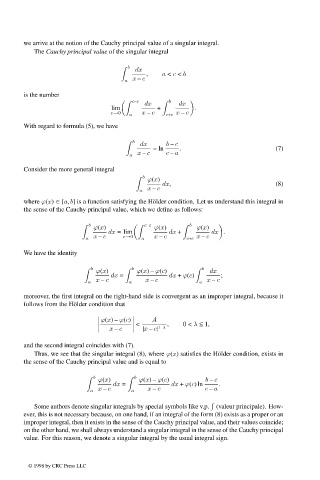
we arrive at the notion of the Cauchy principal value of a singular integral.
                   The Cauchy principal value of the singular integral

                                                 dx
                                                b
                                                     ,   a < c < b
                                                x – c
                                              a
               is the number
                                                 c–ε  dx     b  dx
                                          lim           +          .
                                          ε→0      x – c      x – c
                                               a           c+ε
               With regard to formula (5), we have

                                                   dx      b – c
                                                 b
                                                       =ln     .                            (7)
                                                  x – c    c – a
                                                a
               Consider the more general integral
                                                     ϕ(x)
                                                    b
                                                          dx,                               (8)
                                                     x – c
                                                   a
               where ϕ(x) ∈ [a, b] is a function satisfying the H¨ older condition. Let us understand this integral in
               the sense of the Cauchy principal value, which we define as follows:

                                     ϕ(x)              ϕ(x)         ϕ(x)
                                    b                c–ε           b
                                         dx = lim           dx +        dx .
                                     x – c    ε→0      x – c        x – c
                                  a                a             c+ε
               We have the identity


                                     b           b                     b
                                     ϕ(x)         ϕ(x) – ϕ(c)           dx
                                          dx =              dx + ϕ(c)      ;
                                     x – c          x – c              x – c
                                   a           a                     a
               moreover, the first integral on the right-hand side is convergent as an improper integral, because it
               follows from the H¨ older condition that


                                                      A
                                      	 ϕ(x) – ϕ(c)
                                      	         	  <       ,    0 < λ ≤ 1,
                                         x – c
                                      	         	   |x – c| 1–λ
               and the second integral coincides with (7).
                   Thus, we see that the singular integral (8), where ϕ(x) satisfies the H¨ older condition, exists in
               the sense of the Cauchy principal value and is equal to

                                      ϕ(x)        ϕ(x) – ϕ(c)          b – c
                                      b           b
                                           dx =             dx + ϕ(c)ln    .
                                      x – c          x – c             c – a
                                    a           a

                   Some authors denote singular integrals by special symbols like v.p.  (valeur principale). How-
               ever, this is not necessary because, on one hand, if an integral of the form (8) exists as a proper or an
               improper integral, then it exists in the sense of the Cauchy principal value, and their values coincide;
               on the other hand, we shall always understand a singular integral in the sense of the Cauchy principal
               value. For this reason, we denote a singular integral by the usual integral sign.


                 © 1998 by CRC Press LLC


               © 1998 by CRC Press LLC
                                                                                                             Page 600

