


Page 245 - Handbook of Lasers
P. 245
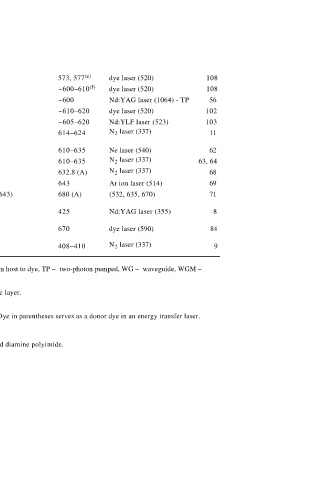
polystyrene (microring laser)  pyrromethane dye  573, 577 (e)  dye laser (520)  108
 polystyrene (microring laser)  pyrromethane dye  ~600–610 (f)  dye laser (520)  108
 polystyrene  rhodamine 640  ~600  Nd:YAG laser (1064) - TP  56
 polystyrene (WGM)  Nile Red  ~610–620  dye laser (520)  102
 polystyrene (WGM)  Nile Red  ~605–620  Nd:YLF laser (523)  103
 polystyrene (WG)  rhodamine 6G  614–624  N 2  laser (337)  11
 polyurethane  rhodamine 6G  610–635  Ne laser (540)  62
 polyurethane  rhodamine 6G  610–635  N 2  laser (337)  63, 64
 polyurethane (film)  rhodamine B  632.8 (A)  N 2  laser (337)  68
 polyurethane  rhodamine 110  643  Ar ion laser (514)  69
 polyurethane  indodicarbocyanine (PK 643)  680 (A)  (532, 635, 670)  71
 polyvinylxylene  dimethyl-POPOP  425  Nd:YAG laser (355)  8
 Probimide 414 (g)  (WG)  cresyl violet 670  670  dye laser (590)  84
 sym-octahydroanthracene (crystal)  anthracene  408–410  N 2  laser (337)  9
 A –  amplified wavelength, EB –  electron beam, ET –  energy transfer from host to dye, TP –  two-photon pumped, WG –  waveguide, WGM –
 whispering galley mode
 (a) Laser emission varied by changing the thickness of the active organic layer.
 (b) See Ref. 20 for molecular structure of copolymer.
 (c) 16% hydroxypropyl acrylate/methyl methacrylate.
 (d) Host materials were polymethylmethacrylate and polyvinylalcohol. Dye in parentheses serves as a donor dye in an energy transfer laser.
 (e) Polymer droplets formed around a 125-mm silica fiber.
 (f)  Polymer droplets formed around a 17-mm silica fiber.
 (g) A photosensitive benzophenone tetracarboxylic diahydride-alkylated diamine polyimide.


 ©2001 CRC Press LLC

