


Page 131 -
P. 131
set parameters


           Use parameters to avoid duplicating

           functions


           Just like it’s a bad idea to use copy’n’paste for repeated usages of code, it’s
           also a bad idea to create multiple copies of a function with only minor
           differences between them. Look again at the proposed send_to_
           twitter_price_low() and send_to_twitter_emergency()
           functions on the previous page; the only difference between them is the
           message they send.

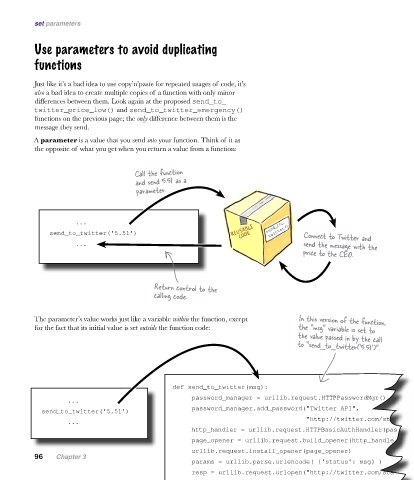
          A parameter is a value that you send into your function. Think of it as
           the opposite of what you get when you return a value from a function:

                                       Call the function
                                       and send 5.51 as a
                                       parameter.


                      ...                                                  send_to_
               send_to_twitter('5.51')                                      twitter()  Connect to Twitter and
                      ...                                                            send the message with the
                                                                                     price to the CEO.


                                            Return control to the
                                            calling code.


           The parameter’s value works just like a variable within the function, except   In this version of the function,
           for the fact that its initial value is set outside the function code:    the “msg" variable is set to
                                                                                    the value passed in by the call
                                                                                    to “send_to_twitter(‘5.51’)".


                                                 def send_to_twitter(msg):
                                                      password_manager = urllib.request.HTTPPasswordMgr()
                    ...
                                                      password_manager.add_password("Twitter API",
             send_to_twitter('5.51')
                                                                                    "http://twitter.com/st
                    ...
                                                      http_handler = urllib.request.HTTPBasicAuthHandler(pas
                                                      page_opener = urllib.request.build_opener(http_handle
                                                      urllib.request.install_opener(page_opener)
           96    Chapter 3
                                                      params = urllib.parse.urlencode( {'status': msg} )
                                                      resp = urllib.request.urlopen("http://twitter.com/sta
                                                      resp.read()

