


Page 515 - High Power Laser Handbook
P. 515
482   Fi b er   L a s er s                              Pulsed Fiber Lasers    483


                                                     1.2
                               0        Signal       1.0


                             −10      ASE           Pulse power (MW)  0.8  450 ps
                            Normalized spectrum (dB)  −20  0.2  −0.5  Time (ns)
                                                     0.6
                                                     0.4


                                                     0.0
                                                                  0.5
                             −30


                             −40                       SRS


                             −50

                                1000       1050        1100       1150
                                                Wavelength (nm)
                                                     (c)
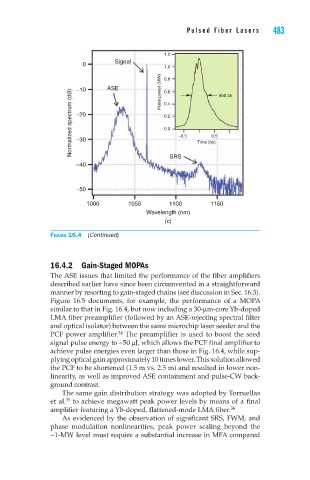
                      Figure 16.4  (Continued)


                      16.4.2  Gain-Staged MOPAs
                      The ASE issues that limited the performance of the fiber amplifiers
                      described earlier have since been circumvented in a straightforward
                      manner by resorting to gain-staged chains (see discussion in Sec. 16.3).
                      Figure  16.5  documents,  for  example,  the  performance  of  a  MOPA
                      similar to that in Fig. 16.4, but now including a 30-μm-core Yb-doped
                      LMA fiber preamplifier (followed by an ASE-rejecting spectral filter
                      and optical isolator) between the same microchip laser seeder and the
                      PCF power amplifier.  The preamplifier is used to boost the seed
                                         34
                      signal pulse energy to ~50 μJ, which allows the PCF final amplifier to
                      achieve pulse energies even larger than those in Fig. 16.4, while sup-
                      plying optical gain approximately 10 times lower. This solution allowed
                      the PCF to be shortened (1.5 m vs. 2.5 m) and resulted in lower non-
                      linearity, as well as improved ASE containment and pulse-CW back-
                      ground contrast.
                         The same gain distribution strategy was adopted by Torruellas
                      et al.  to achieve megawatt peak power levels by means of a final
                          35
                      amplifier featuring a Yb-doped, flattened-mode LMA fiber.
                                                                       36
                         As evidenced by the observation of significant SRS, FWM, and
                      phase  modulation  nonlinearities,  peak  power  scaling  beyond  the
                      ~1-MW level must require a substantial increase in MFA compared

