


Page 514 - Introduction to Continuum Mechanics
P. 514
498 Special Single Integral Type Nonlinear Constitutive Equations

         special cases. In this most general form, only very special flow problems can be solved. A class
         of such flows, called the viscometric flow, will be considered in Part C, using this general form
         of constitutive equation. However, in the following few sections, we shall first discuss some
         special constitutive equations. Some of these constitutive equations have been shown to be
         approximations to the general constitutive equation given in Eq. (8.14.2) under certain
         conditions (slow flow and/or fading memory). They can also be considered simply as special
         fluids. For example, a Newtonian incompressible fluid can be considered either as a special
         fluid by itself or as an approximation to the general simple fluid when it has no memory of its
         past history of deformation and is under slow flow condition relative to its relaxation time
         (which is zero).

         8.15 Special Single Integral Type Nonlinear Constitutive Equations

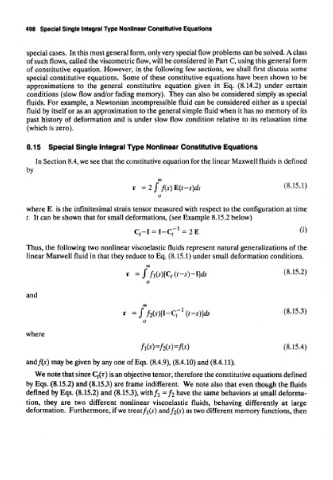
           In Section 8.4, we see that the constitutive equation for the linear Maxwell fluids is defined
         by


         where E is the infinitesimal strain tensor measured with respect to the configuration at time
         t. It can be shown that for small deformations, (see Example 8.15.2 below)


         Thus, the following two nonlinear viscoelastic fluids represent natural generalizations of the
         linear Maxwell fluid in that they reduce to Eq. (8.15.1) under small deformation conditions.


         and


         where


         and/(s) may be given by any one of Eqs. (8.4.9), (8.4.10) and (8.4.11).
           We note that since Q(r) is an objective tensor, therefore the constitutive equations defined
         by Eqs. (8.15.2) and (8.15.3) are frame indifferent. We note also that even though the fluids
         defined by Eqs. (8.15.2) and (8.15.3), with/j =/ 2 have the same behaviors at small deforma-
         tion, they are two different nonlinear viscoelastic fluids, behaving differently at large
         deformation. Furthermore, if we treat f\(s) and/2(s) as two different memory functions, then

