


Page 141 - Matrices theory and applications
P. 141
7. Exponential of a Matrix, Polar Decomposition, and Classical Groups
124
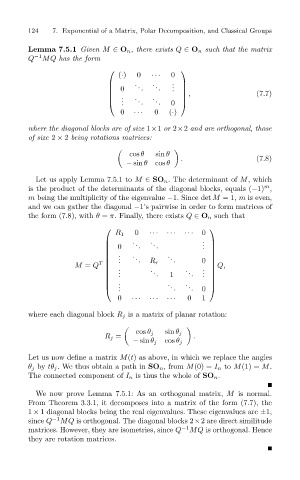
Lemma 7.5.1 Given M ∈ O n ,there exists Q ∈ O n such that the matrix
−1
Q
MQ has the form
(·)
0
0
.
.
.
.
.
.
0
.
.
.
.
.
.
.
0
0
0 . ··· . . ··· . . (·) , (7.7)
where the diagonal blocks are of size 1×1 or 2×2 and are orthogonal, those
of size 2 × 2 being rotations matrices:
cos θ sin θ
. (7.8)
− sin θ cos θ
Let us apply Lemma 7.5.1 to M ∈ SO n . The determinant of M,which
m
is the product of the determinants of the diagonal blocks, equals (−1) ,
m being the multiplicity of the eigenvalue −1. Since det M =1, m is even,
and we can gather the diagonal −1’s pairwise in order to form matrices of
the form (7.8), with θ = π. Finally, there exists Q ∈ O n such that
R 1 0 ··· ··· ··· 0
. .
0 . . . . . .
.
. . .
. . . . . . 0
M = Q T R r Q,
. . .
. . . .
. . 1 . . .
. . .
. . . . . . 0
0 ··· ··· ··· 0 1
where each diagonal block R j is a matrix of planar rotation:
cos θ j sin θ j
R j = .
− sin θ j cos θ j
Let us now define a matrix M(t) as above, in which we replace the angles
θ j by tθ j . We thus obtain a path in SO n ,from M(0) = I n to M(1) = M.
The connected component of I n is thus the whole of SO n .
We now prove Lemma 7.5.1: As an orthogonal matrix, M is normal.
From Theorem 3.3.1, it decomposes into a matrix of the form (7.7), the
1 × 1 diagonal blocks being the real eigenvalues. These eigenvalues are ±1,
since Q −1 MQ is orthogonal. The diagonal blocks 2×2 are direct similitude
matrices. However, they are isometries, since Q −1 MQ is orthogonal. Hence
they are rotation matrices.

