


Page 243 - MODELING OF ASPHALT CONCRETE
P. 243
Unified Disturbed State Constitutive Modeling of Asphalt Concr ete      221


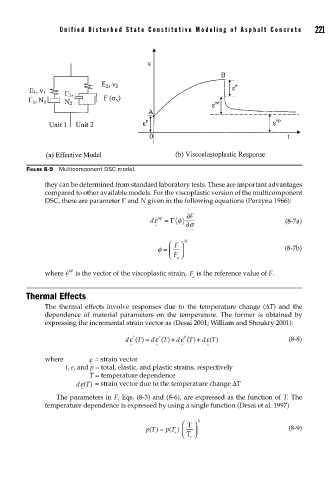
               FIGURE 8-9  Multicomponent DSC model.

                    they can be determined from standard laboratory tests. These are important advantages
                    compared to other available models. For the viscoplastic version of the multicomponent
                    DSC, there are parameter Γ and N given in the following equations (Perzyna 1966):
                                                            ∂ F
                                                  d 	 ε up  = Γ  φ  ∂ σ                 (8-7a)
                                                   ~
                                                             ~
                                                       ⎛ F  ⎞  N
                                                    φ =  ⎜  ⎟                           (8-7b)
                                                       ⎝ F o  ⎠
                           up
                    where  	 ε  is the vector of the viscoplastic strain,  F  is the reference value of F.
                          ~                                   o
               Thermal Effects
                    The thermal effects involve responses due to the temperature change (ΔT) and the
                    dependence of material parameters on the temperature. The former is obtained by
                    expressing the incremental strain vector as (Desai 2001; William and Shoukry 2001):

                                             t
                                                    e
                                                            p
                                           dε () =  dε () +  dε () +  d T                (8-8)
                                              T
                                                      T
                                                                  ε()
                                                             T
                                            ~      ~       ~      ~
                    where        ε  = strain vector
                                 ~
                          t, e, and p = total, elastic, and plastic strains, respectively
                                 T = temperature dependence
                             dT  = strain vector due to the temperature change ΔT
                              ε()
                              ~
                       The parameters in F, Eqs. (8-3) and (8-6), are expressed as the function of T. The
                    temperature dependence is expressed by using a single function (Desai et al. 1997)
                                                 pT() =  pT )  ⎛ T  ⎞ ⎟ λ                (8-9)
                                                       (
                                                         r ⎜
                                                           ⎝ T r  ⎠

