


Page 368 -
P. 368
366                                                     G. Decket et al.
                           extent to which the transformation can transform BPMN models into YAWL mod-
                           els. The transformation outlined in this paper has been implemented in a freely
                           available tool, namely BPMN2YAWL.
                              The chapter relies on version 1.0 of the BPMN standard specification. At the
                           time of writing this chapter, version 2 of the BPMN specification is being finalized.
                           This new version will bring some significant changes with respect to the previous
                           one. In particular, a new type of event will be introduced, namely escalation. An
                           escalation event is raised by a user in order to signal that an exception has occurred
                           and that appropriate actions need to be taken, for example, canceling the task or
                           initiating another task in parallel. This concept is similar to the concept of exlet in
                           YAWL. Also, a stricter approach to define data attached to tasks will be introduced
                           in BPMN 2.0, inspired in great part by the data definition approach used in BPEL.
                           Such changes will have some impact on the mapping between BPMN and YAWL.
                           Still, most of the mapping principles outlined in this chapter will remain applicable.


                           Exercises


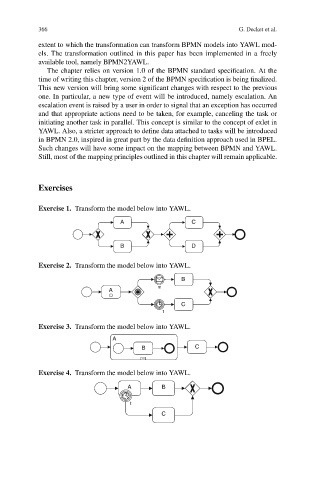
                           Exercise 1. Transform the model below into YAWL.
                                                  A                   C


                                                  B                   D

                           Exercise 2. Transform the model below into YAWL.

                                                                   B
                                                            m
                                               A
                                                                   C
                                                              t
                           Exercise 3. Transform the model below into YAWL.
                                                A
                                                        B              C


                           Exercise 4. Transform the model below into YAWL.

                                                    A         B

                                                     t
                                                             C

