


Page 174 - Modern physical chemistry
P. 174
166                       Relationships among Reactants

               7.6  What can cause the calorimetric entropy to be in error?
               7.7  Estimate the entropy excess for (a) CO, (b) H2 0.
              7.8  How does one obtain (a) the standard Gibbs energy change,  (b) the standard Helmholtz
                   energy change, in a reaction from calorimetric data?
               7.9  How is the chemical potential related to the activity of a constituent in a phase?
              7.10  Define the Gibbs energy of reaction and the Helmholtz energy of reaction.
              7.11  Distinguish between the pressure reaction quotient, the concentration reaction quotient,
                   and the activity reaction quotient.
              7.12  Distinguish between equilibrium constants K, Kp,  and Kc.
              7.13  How are these equilibrium constants related to changes in thermodynamic properties?
              7.14  How does one employ an equilibrium constant in determining the equilibrium state for a
                   gaseous system?
              7.15  How are heterogeneous gas equilibria treated?
              7.16  Explain how equilibrium constants vary with (a) temperature, (b) pressure.
              7.17  Define and describe an activity coefficient (a) for partial pressure, (b) for concentration.


             Problems

              7.1  When 60.0 ml 0.500 M acetic acid was mixed with 60.0 ml 0.500 M sodium hydroxide, the tem-
                   perature rose from 25.00 0  to 27.55 0  C.  If the energy capacity of the 0.250 M sodium acetate
                  formed was 4.029 J Kl g-l , its density 1.034 g ml- l , and the effective energy capacity of the empty
                   calorimeter 150.6 J Kl , what is !:J{ for the corresponding neutralization of 1 mole acetic acid?
              7.2  When 1 mole liquid n-pentane, CJ:I12, is oxidized completely to gaseous CO2  and liquid H2 0
                   at 25 0  C, !:J{ is -3509.5 kJ. Calculate tlE for the reaction.
              7.3  From the reaction heats

                         co (g)  +! O2 (g) ~ CO2 (g),      tJf&S.15 = -282.96 kJ,
                                  2
                                 1
                         H2  (g)+-02 (g)~ H20  (g),        tJf&S.15 = -241.84 kJ,
                                 2
                  calculate Mf! 2f118.l5  for
                                    CO2 (g) + H2 (g) ~ CO (g) + H20  (g).
              7.4  Calculate the entropy of solid NH 40H at 15.0 K,  where its energy capacity Cp  is
                   1. 753 J Kl mot l  •
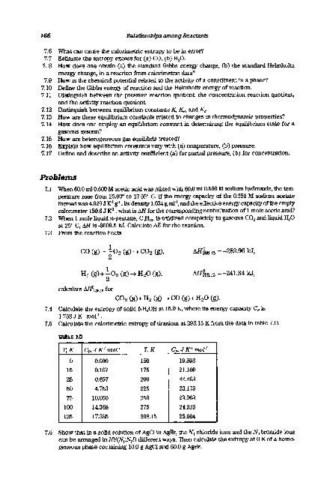
              7.5  Calculate the calorimetric entropy of titanium at 298.15 K from the data in table 7.D.
                  TABLE7.D

                    T,K   Cpt  J KI mot l   T,K     Cpt  J KI mot l
                      0      0.000         150         19.598
                     15      0.167         175         21.100
                     25      0.657         200         22.263
                     50      4.753         225         23.175
                     75      10.050        250         23.903
                    100      14.368        275         24.535
                    125      17.385        298.15      25.004

              7.6  Show that in a solid solution of AgCI in AgBr, the Nl chloride ions and the N2 bromide ions
                  can be arranged in N!/(NI !N2!) different ways. Then calculate the entropy at 0 K of a homo-
                  geneous phase containing 10.0 g AgCI and 50.0 g AgBr.

