


Page 151 - Neural Network Modeling and Identification of Dynamical Systems
P. 151
4.3 APPLICATION OF ANN MODELS TO ADAPTIVE CONTROL PROBLEMS UNDER UNCERTAINTY CONDITIONS  141


                                                                                                u
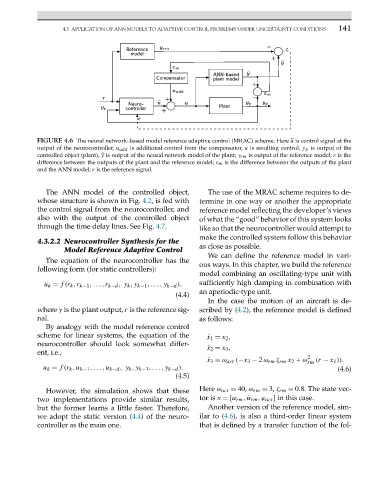
                          FIGURE 4.6 The neural network–based model reference adaptive control (MRAC) scheme. Here  is control signal at the
                          output of the neurocontroller, u add is additional control from the compensator, u is resulting control, y p is output of the
                                            y
                          controlled object (plant),  is output of the neural network model of the plant; y rm is output of the reference model; ε is the
                          difference between the outputs of the plant and the reference model; ε m is the difference between the outputs of the plant
                          and the ANN model; r is the reference signal.

                            The ANN model of the controlled object,      The use of the MRAC scheme requires to de-
                          whose structure is shown in Fig. 4.2,isfed with  termine in one way or another the appropriate
                          the control signal from the neurocontroller, and  reference model reflecting the developer’s views
                          also with the output of the controlled object  of what the “good” behavior of this system looks
                          through the time delay lines. See Fig. 4.7.  like so that the neurocontroller would attempt to
                                                                       make the controlled system follow this behavior
                          4.3.2.2 Neurocontroller Synthesis for the
                                 Model Reference Adaptive Control      as close as possible.
                                                                         We can define the reference model in vari-
                            The equation of the neurocontroller has the
                          following form (for static controllers):     ous ways. In this chapter, we build the reference
                                                                       model combining an oscillating-type unit with
                            u k = f(r k ,r k−1 ,...,r k−d ,y k ,y k−1 ,...,y k−d ),  sufficiently high damping in combination with
                                                                       an aperiodic-type unit.
                                                                (4.4)
                                                                         In the case the motion of an aircraft is de-
                          where y is the plant output, r is the reference sig-  scribed by (4.2), the reference model is defined
                          nal.                                         as follows:
                            By analogy with the model reference control
                          scheme for linear systems, the equation of the  ˙ x 1 = x 2 ,
                          neurocontroller should look somewhat differ-
                                                                         ˙ x 2 = x 3 ,
                          ent, i.e.,
                                                                         ˙ x 3 = ω act (−x 3 − 2ω rm ζ rm x 2 + ω 2  (r − x 1 )).
                                                                                                     rm
                           u k = f(r k ,u k−1 ,...,u k−d ,y k ,y k−1 ,...,y k−d ).                           (4.6)
                                                                (4.5)
                            However, the simulation shows that these   Here ω act = 40, ω rm = 3, ζ rm = 0.8. The state vec-
                          two implementations provide similar results,  tor is x =[α rm , ˙α rm ,ϕ act ] in this case.
                          but the former learns a little faster. Therefore,  Another version of the reference model, sim-
                          we adopt the static version (4.4) of the neuro-  ilar to (4.6), is also a third-order linear system
                          controller as the main one.                  that is defined by a transfer function of the fol-

