


Page 232 - New Trends In Coal Conversion
P. 232
194                                            New Trends in Coal Conversion


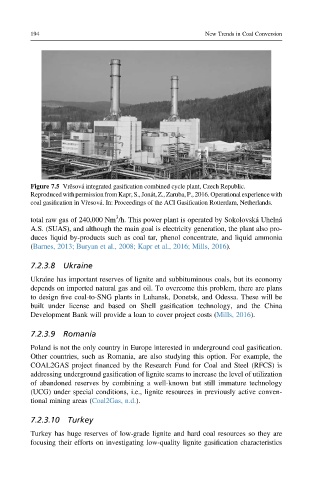
         Figure 7.5 Vrêsov  a integrated gasification combined cycle plant, Czech Republic.
         Reproduced withpermissionfromKapr, S., Jon  at,Z., Zaruba,P., 2016. Operational experiencewith
         coal gasification in V  resov  a. In: Proceedings of the ACI Gasification Rotterdam, Netherlands.
                                3
         total raw gas of 240,000 Nm /h. This power plant is operated by Sokolovsk  a Uheln  a
         A.S. (SUAS), and although the main goal is electricity generation, the plant also pro-
         duces liquid by-products such as coal tar, phenol concentrate, and liquid ammonia
         (Barnes, 2013; Buryan et al., 2008; Kapr et al., 2016; Mills, 2016).

         7.2.3.8  Ukraine

         Ukraine has important reserves of lignite and subbituminous coals, but its economy
         depends on imported natural gas and oil. To overcome this problem, there are plans
         to design five coal-to-SNG plants in Luhansk, Donetsk, and Odessa. These will be
         built under license and based on Shell gasification technology, and the China
         Development Bank will provide a loan to cover project costs (Mills, 2016).

         7.2.3.9  Romania
         Poland is not the only country in Europe interested in underground coal gasification.
         Other countries, such as Romania, are also studying this option. For example, the
         COAL2GAS project financed by the Research Fund for Coal and Steel (RFCS) is
         addressing underground gasification of lignite seams to increase the level of utilization
         of abandoned reserves by combining a well-known but still immature technology
         (UCG) under special conditions, i.e., lignite resources in previously active conven-
         tional mining areas (Coal2Gas, n.d.).

         7.2.3.10 Turkey

         Turkey has huge reserves of low-grade lignite and hard coal resources so they are
         focusing their efforts on investigating low-quality lignite gasification characteristics

