


Page 149 -
P. 149
136   Chapter Nine


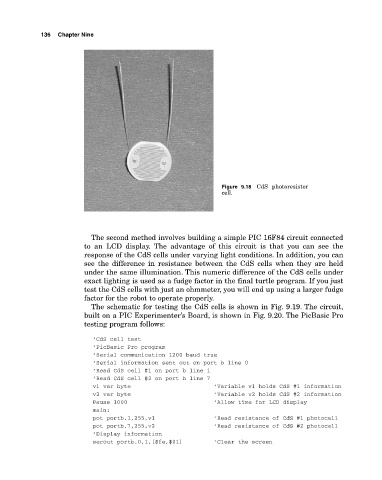
                                                               Figure 9.18  CdS photoresistor
                                                               cell.


                          The second method involves building a simple PIC 16F84 circuit connected
                        to an LCD display.  The advantage of this circuit is that you can see the
                        response of the CdS cells under varying light conditions. In addition, you can
                        see the difference in resistance between the CdS cells when they are held
                        under the same illumination. This numeric difference of the CdS cells under
                        exact lighting is used as a fudge factor in the final turtle program. If you just
                        test the CdS cells with just an ohmmeter, you will end up using a larger fudge
                        factor for the robot to operate properly.
                          The schematic for testing the CdS cells is shown in Fig. 9.19. The circuit,
                        built on a PIC Experimenter’s Board, is shown in Fig. 9.20. The PicBasic Pro
                        testing program follows:
                           ‘CdS cell test
                           ‘PicBasic Pro program
                           ‘Serial communication 1200 baud true
                           ‘Serial information sent out on port b line 0
                           ‘Read CdS cell #1 on port b line 1
                           ‘Read CdS cell #2 on port b line 7
                           v1 var byte                      ‘Variable v1 holds CdS #1 information
                           v2 var byte                      ‘Variable v2 holds CdS #2 information
                           Pause 1000                       ‘Allow time for LCD display
                           main:
                           pot portb.1,255,v1               ‘Read resistance of CdS #1 photocell
                           pot portb.7,255,v2               ‘Read resistance of CdS #2 photocell
                           ‘Display information
                           serout portb.0,1,[$fe,$01]       ‘Clear the screen

