


Page 452 - Petrophysics 2E
P. 452
420    PETROPHYSICS: RESERVOIR ROCK PROPERTIES


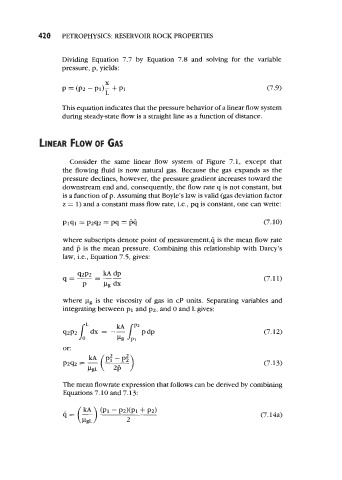
                    Dividing  Equation  7.7 by  Equation  7.8  and  solving  for  the  variable
                    pressure, p, yields:

                                 X
                    P = (P2 - Pl),  + PI                                          (7.9)


                    This equation indicates that the pressure behavior of a linear flow system
                    during steady-state flow is a straight line as a function of distance.


             LINEAR FLOW OF GAS


                      Consider  the  same  linear flow  system  of  Figure  7.1,  except  that
                    the flowing fluid is now natural gas.  Because the gas expands as the
                    pressure declines, however, the pressure gradient increases toward the
                    downstream end and, consequently, the flow rate q is not constant, but
                    is a function of p. Assuming that Boyle’s law is valid (gas deviation factor
                    z = 1) and a constant mass flow rate, i.e., pq is constant, one can write:


                    Plql = p2q2 = Pq = PCl                                       (7.10)

                    where subscripts denote point of measurement,q is the mean flow rate
                    and p is the mean pressure. Combining this relationship with Darcy’s
                    law, i.e., Equation 7.5, gives:


                         92P2    kAdP
                    q=-=--                                                       (7.11)
                          P      Pg dx
                    where pg is the viscosity of  gas in  CP units.  Separating variables and
                    integrating between p1 and p2, and 0 and L gives:


                    q2P2~Ldx                                                     (7.12)
                                = -- kA SP2 PdP
                                     Ps  p1
                    or:

                    p2q2 = - kA (2) PFP2                                         (7.13)
                            CLgL
                    The mean flowrate expression that follows can be derived by combining
                     Equations 7.10 and 7.13:
                                (pl
                     q = (E) - p2)(p1 + p2)
                                                                                 (7.14a)
                                        2

