


Page 529 - Petrophysics
P. 529
INDICATORS OF NATURAL FRACTURES              497


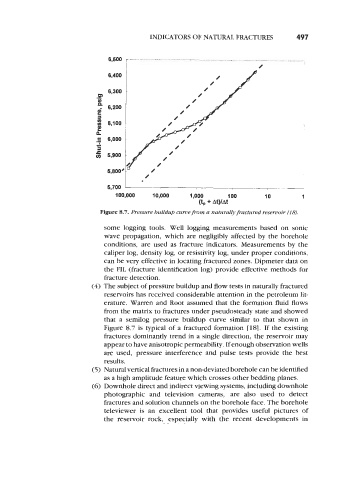
                                Figure 8.7. Pressure buildup curve from a naturally fractured reservoir [I SJ,

                                 some logging  tools.  Well  logging  measurements based  on  sonic
                                 wave propagation, which  are negligibly affected by  the borehole
                                 conditions, are used  as fracture indicators. Measurements by  the
                                 caliper log, density log, or resistivity log, under proper conditions,
                                 can be very effective in locating fractured zones. Dipmeter data on
                                 the FIL (fracture identification log) provide effective methods for
                                 fracture detection.
                             (4)  The subject of pressure buildup and flow tests in naturally fractured
                                 reservoirs has received considerable attention in the petroleum lit-
                                 erature. Warren and Root  assumed that the formation fluid flows
                                 from the matrix to fractures under pseudosteady state and showed
                                 that  a  semilog pressure  buildup  curve  similar  to  that  shown  in
                                 Figure 8.7 is typical of  a fractured formation  [18]. If  the  existing
                                 fractures dominantly trend in a single direction, the reservoir may
                                 appear to have anisotropic permeability.  If enough observation wells
                                 are used,  pressure interference and  pulse  tests  provide  the best
                                 results.
                             (5)  Natural vertical fractures in a non-deviated borehole can be identified
                                 as a high amplitude feature which crosses other bedding planes.
                             (6)  Downhole direct and indirect viewing systems, including downhole
                                 photographic  and  television  cameras,  are  also  used  to  detect
                                 fractures and solution channels on the borehole face. The borehole
                                 televiewer  is  an  excellent  tool  that  provides  useful  pictures  of
                                 the  reservoir  rock,  especially  with  the  recent  developments  in

