


Page 118 - Physical Chemistry
P. 118
lev38627_ch03.qxd  2/29/08  3:12 PM  Page 99


                                                                                                                  99
                              1
                          1
                                  1
                  tossed is    . Since parts 1 and 2 behave independently of each other, we have              Section 3.7
                          2
                              2
                                  4
                  p       p p . Equation (3.48) becomes                                                   What Is Entropy?
                   1 2    1 2
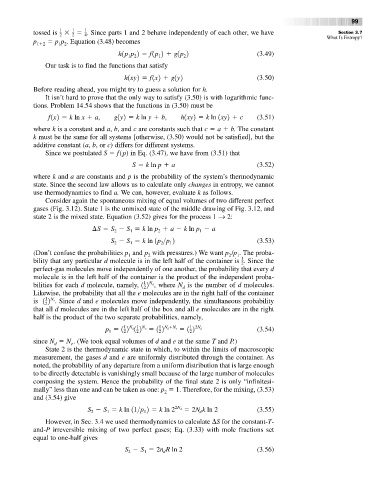
                                            h1p p 2   f1p 2   g1p 2                  (3.49)
                                                        1
                                                               2
                                               1 2
                      Our task is to find the functions that satisfy
                                              h1xy2   f1x2   g1y2                    (3.50)
                  Before reading ahead, you might try to guess a solution for h.
                      It isn’t hard to prove that the only way to satisfy (3.50) is with logarithmic func-
                  tions. Problem 14.54 shows that the functions in (3.50) must be
                       f1x2   k ln x   a,   g1y2   k ln y   b,   h1xy2   k ln 1xy2   c  (3.51)
                  where k is a constant and a, b, and c are constants such that c   a   b. The constant
                  k must be the same for all systems [otherwise, (3.50) would not be satisfied], but the
                  additive constant (a, b, or c) differs for different systems.
                      Since we postulated S   f(p) in Eq. (3.47), we have from (3.51) that
                                                S   k ln p   a                       (3.52)
                  where k and a are constants and p is the probability of the system’s thermodynamic
                  state. Since the second law allows us to calculate only changes in entropy, we cannot
                  use thermodynamics to find a. We can, however, evaluate k as follows.
                      Consider again the spontaneous mixing of equal volumes of two different perfect
                  gases (Fig. 3.12). State 1 is the unmixed state of the middle drawing of Fig. 3.12, and
                  state 2 is the mixed state. Equation (3.52) gives for the process 1 → 2:
                                    ¢S   S   S   k ln p   a   k ln p   a
                                                        2
                                                                    1
                                           2
                                               1
                                            S   S   k ln 1p >p 2                     (3.53)
                                                         2
                                               1
                                                           1
                                           2
                  (Don’t confuse the probabilities p and p with pressures.) We want p /p . The proba-
                                               1
                                                     2
                                                                               1
                                                                             2
                                                                                 1
                  bility that any particular d molecule is in the left half of the container is  . Since the
                                                                                 2
                  perfect-gas molecules move independently of one another, the probability that every d
                  molecule is in the left half of the container is the product of the independent proba-
                  bilities for each d molecule, namely,  1 2 ,  where N is the number of d molecules.
                                                   1 N d
                                                   2
                                                               d
                  Likewise, the probability that all the e molecules are in the right half of the container
                  is  1 2 .  Since d and e molecules move independently, the simultaneous probability
                      1 N e
                      2
                  that all d molecules are in the left half of the box and all e molecules are in the right
                  half is the product of the two separate probabilities, namely,
                                        p   1 2 1 2    1 2      1 2                  (3.54)
                                                        1 N d  N e
                                                                 1 2N d
                                             1 N d 1 N e
                                         1
                                                                 2
                                                        2
                                                 2
                                             2
                  since N   N . (We took equal volumes of d and e at the same T and P.)
                              e
                         d
                      State 2 is the thermodynamic state in which, to within the limits of macroscopic
                  measurement, the gases d and e are uniformly distributed through the container. As
                  noted, the probability of any departure from a uniform distribution that is large enough
                  to be directly detectable is vanishingly small because of the large number of molecules
                  composing the system. Hence the probability of the final state 2 is only “infinitesi-
                  mally” less than one and can be taken as one: p   1. Therefore, for the mixing, (3.53)
                                                          2
                  and (3.54) give
                                   S   S   k ln 11>p 2   k ln 2 2N d    2N k ln 2    (3.55)
                                                                    d
                                        1
                                    2
                                                   1
                      However, in Sec. 3.4 we used thermodynamics to calculate  S for the constant-T-
                  and-P irreversible mixing of two perfect gases; Eq. (3.33) with mole fractions set
                  equal to one-half gives
                                              S   S   2n R ln 2                      (3.56)
                                               2
                                                    1
                                                         d

