


Page 334 - Practical Ship Design
P. 334
Structural  Design                                                  29 1


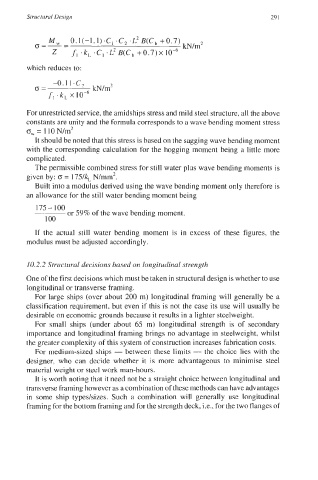
                     O,l(-l.l).C,  .C, .L2 B(C, +0.7)
               M,  -
           (T=-    -                                kN/m2
                2    f, k,  .C, .L2 B(C, +0.7)x
                        .
        which reduces to:
                -0.11 .c,
           o=              W/m2
              f, . k, x

        For unrestricted service, the amidships stress and mild steel structure, all the above
        constants are unity and the formula corresponds to a wave bending moment stress
        ow = 1 10 N/m2
           It should be noted that this stress is based on the sagging wave bending moment
        with the corresponding  calculation  for the hogging moment being  a little more
        complicated.
           The permissible combined stress for still water plus wave bending moments is
        given by: o = 175/kL N/mm2.
           Built into a modulus derived using the wave bending moment only therefore is
        an allowance for the still water bending moment being

           175-  100  or 59% of the wave bending moment.
              100

           If  the  actual  still  water  bending  moment  is  in  excess  of  these  figures, the
        modulus must be adjusted accordingly.

         10.2.2 Structural decisions based on longitudinal strength

        One of the first decisions which must be taken in structural design is whether to use
        longitudinal or transverse framing.
           For large ships (over about  200 m) longitudinal  framing will generally be a
        classification  requirement, but even if this is not the case its use will usually be
        desirable on economic grounds because it results in a lighter steelweight.
           For  small  ships  (under  about  65  m)  longitudinal  strength  is  of  secondary
         importance and longitudinal framing brings no advantage in steelweight, whilst
        the greater complexity of this system of construction increases fabrication costs.
           For medium-sized  ships - between  these limits - the choice lies with the
        designer,  who  can  decide  whether  it  is  more  advantageous  to  minimise  steel
        material weight or steel work man-hours.
           It is worth noting that it need not be a straight choice between longitudinal and
        transverse framing however as a combination of these methods can have advantages
        in  some  ship  typedsizes.  Such  a  combination  will  generally  use  longitudinal
        framing for the bottom framing and for the strength deck, i.e., for the two flanges of

