


Page 341 - Practical Ship Design
P. 341
298                                                            Chapter 10


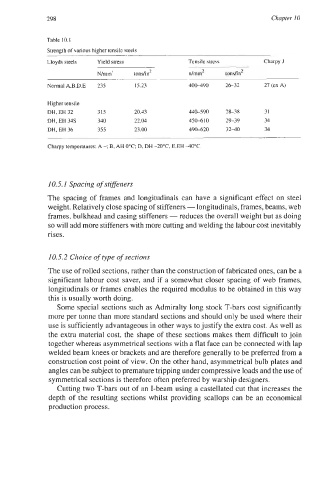
              Table 10.1
              Strength of various higher tensile steels
              Lloyds steels   Yield stress            Tensile stress       CharpY J
                            Nlmm'     tons/in2        n/mrn2    tons/in2
              Normal A,B,D,E   235    15.23           400-490   26-32      27 (ex A)


              Higher tensile
              DH, EH 32     315       20.43           440-590   28-38      31
              DH, EH 34s    340       22.04           450410    29-39      34
              DH, EH 36     355       23.00           490-620   3240       34

              Charpy temperatures: A -; B, AH 0°C; D, DH -20"C, E,EH 40°C.


              10.5. I  Spacing of  stifSeners

              The spacing of  frames and  longitudinals  can have a  significant  effect on  steel
              weight. Relatively close spacing of stiffeners - longitudinals, frames, beams, web
              frames, bulkhead and casing stiffeners - reduces the overall weight but as doing
              so will add more stiffeners with more cutting and welding the labour cost inevitably
              rises.


              10.5.2 Choice of  type of  sections
              The use of rolled sections, rather than the construction of fabricated ones, can be a
              significant labour cost saver, and if  a somewhat closer spacing of  web frames,
              longitudinals or frames enables the required modulus to be obtained in this way
              this is usually worth doing.
                 Some special sections such as Admiralty long stock T-bars cost significantly
              more per tonne than more standard sections and should only be used where their
              use is sufficiently advantageous in other ways to justify the extra cost. As well as
              the extra material cost, the shape of these sections makes them difficult to join
              together whereas asymmetrical sections with a flat face can be connected with lap
              welded beam knees or brackets and are therefore generally to be preferred from a
              construction cost point of view. On the other hand, asymmetrical bulb plates and
              angles can be subject to premature tripping under compressive loads and the use of
              symmetrical sections is therefore often preferred by warship designers.
                 Cutting two T-bars out of an I-beam using a castellated cut that increases the
              depth of  the resulting  sections whilst providing  scallops can be  an economical
              production process.

