


Page 373 - Practical Ship Design
P. 373
Chapter 11


                  Training required  for personnel  to  enable  them  to  deal  with  the  special
                  characteristics of, and special requirements on board Ro-Ro ships.
                  Communications, both within the ship and between the ship and the outside
                  world.
                  The adequacy  of lifesaving appliances.
                  The adequacy of search and rescue arrangements.
                   Overall safety assessment and risk analysis.
                   Ship/operator relations including the international safety management code.
                   Survey and inspection.

                  of the most significant changes from previous rules is the requirement that
              calculations of survivability after damage be based on the ship being in seas with a
              wave height  appropriate to the  sea area in which the  ship operates, this  figure
              generally lying between 2 and 4 m.
                When Stena Line decided to introduce high speed passenger and car ferries to
              their Holyhead-Dun  Laoghaire service, they wisely decided that the novelty of this
              type of design demanded the adoption of the safety case approach.
                A 1997 R.I.N.A. paper by Kuo, Pryka, Sodahl and Craufurd entitled “A Safety
              Case for Stena Line’s High Speed Ferry HSS 1500” gives a useful introduction to
              safety case methodology.
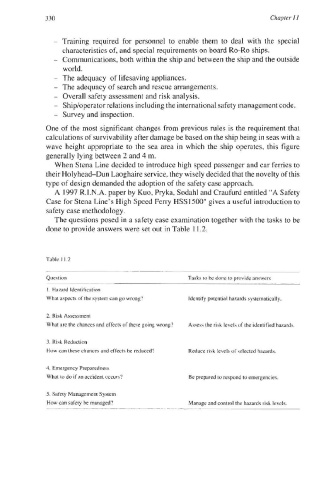
                The questions posed in a safety case examination together with the tasks to be
              done to provide answers were set out in Table 1 1.2.


              Table 1 1.2

              Question                                Tasks to be done to provide answers
              I. Hazard Identification
              What aspects of the system can go wrong?   Identify potential hazards systematically.

              2. Risk Assessment
              What are the chances and effects of these going wrong?   Assess the risk levels of the identified hazards.

              3. Risk Reduction
              How can these chances and effects be reduced?   Reduce risk levels of selected hazards.

              4. Emergency Preparedness
              What to do if an accident occurs?       Be prepared to respond to emergencies.

              5. Safety Management System
              How can safety be managed?              Manage and control the hazards risk levels.

