


Page 17 - Robotics Designing the Mechanisms for Automated Machinery
P. 17
6             Introduction: Brief Historical Review and Main Definitions


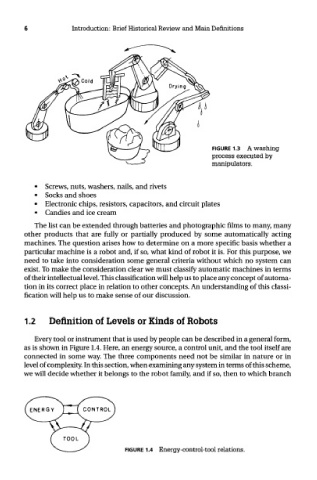
                                                              FIGURE 1.3 A washing
                                                              process executed by
                                                              manipulators.


           • Screws, nuts, washers, nails, and rivets
           • Socks and shoes
           • Electronic chips, resistors, capacitors, and circuit plates
           • Candies and ice cream
           The list can be extended through batteries and photographic films to many, many
        other products that are fully or partially produced by some automatically acting
        machines. The question arises how to determine on a more specific basis whether a
        particular machine is a robot and, if so, what kind of robot it is. For this purpose, we
        need to take into consideration some general criteria without which no system can
        exist. To make the consideration clear we must classify automatic machines in terms
        of their intellectual level. This classification will help us to place any concept of automa-
        tion in its correct place in relation to other concepts. An understanding of this classi-
        fication will help us to make sense of our discussion.


        1.2    Definition of Levels or Kinds of Robots

           Every tool or instrument that is used by people can be described in a general form,
        as is shown in Figure 1.4. Here, an energy source, a control unit, and the tool itself are
        connected in some way. The three components need not be similar in nature or in
        level of complexity. In this section, when examining any system in terms of this scheme,
        we will decide whether it belongs to the robot family, and if so, then to which branch


                                     FIGURE 1.4 Energy-control-tool relations.

