


Page 540 - Rock Mechanics For Underground Mining
P. 540
BLASTING MECHANICS


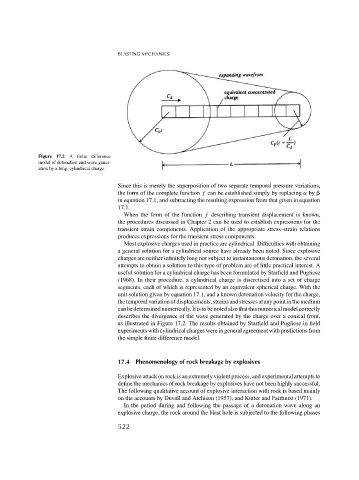
              Figure 17.2  A finite difference
              model of detonation and wave gener-
              ation by a long, cylindrical charge.


                                        Since this is merely the superposition of two separate temporal pressure variations,
                                        the form of the complete function f can be established simply by replacing   by
                                        in equation 17.1, and subtracting the resulting expression from that given in equation
                                        17.1.
                                          When the form of the function f describing transient displacement is known,
                                        the procedures discussed in Chapter 2 can be used to establish expressions for the
                                        transient strain components. Application of the appropriate stress–strain relations
                                        produces expressions for the transient stress components.
                                          Most explosive charges used in practice are cylindrical. Difficulties with obtaining
                                        a general solution for a cylindrical source have already been noted. Since explosive
                                        charges are neither infinitely long nor subject to instantaneous detonation, the several
                                        attempts to obtain a solution to this type of problem are of little practical interest. A
                                        useful solution for a cylindrical charge has been formulated by Starfield and Pugliese
                                        (1968). In their procedure, a cylindrical charge is discretised into a set of charge
                                        segments, each of which is represented by an equivalent spherical charge. With the
                                        unit solution given by equation 17.1, and a known detonation velocity for the charge,
                                        thetemporal variation of displacements, strains andstresses atanypointin the medium
                                        canbedeterminednumerically.Itistobenotedalsothatthisnumericalmodelcorrectly
                                        describes the divergence of the wave generated by the charge over a conical front,
                                        as illustrated in Figure 17.2. The results obtained by Starfield and Pugliese in field
                                        experiments with cylindrical charges were in general agreement with predictions from
                                        the simple finite difference model.


                                        17.4 Phenomenology of rock breakage by explosives

                                        Explosive attack on rock is an extremely violent process, and experimental attempts to
                                        define the mechanics of rock breakage by explosives have not been highly successful.
                                        The following qualitative account of explosive interaction with rock is based mainly
                                        on the accounts by Duvall and Atchison (1957), and Kutter and Fairhurst (1971).
                                          In the period during and following the passage of a detonation wave along an
                                        explosive charge, the rock around the blast hole is subjected to the following phases
                                        522

