


Page 135 - Standard Handbook Of Petroleum & Natural Gas Engineering
P. 135
120   Mathematics

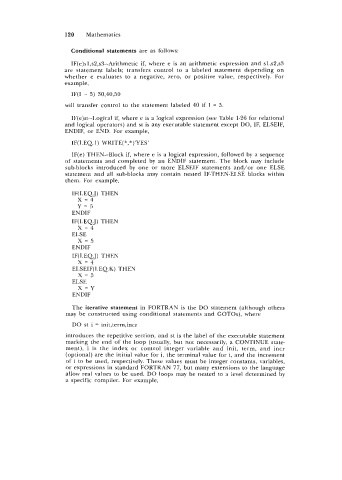
                       Conditional statements  are as follows:

                       IF(e)sl,sP,s3-Arithmetic if,  where  e  is  an arithmetic expression  and sl,s2,s3
                     are  statement labels;  transfers  control  to  a  labeled  statement  depending on
                     whether  e  evaluates  to  a  negative,  zero,  or  positive  value,  respectively.  For
                     example,
                       IF(I  - 5) 30,40,50
                     will  transfer  control  to  the statement  labeled 40 if  I  = 5.

                       IF(e)st-Logical  if, where e is a logical  expression (see Table 1-26 for relational
                     and logical  operators) and st is any executable statement except DO, IF, ELSEIF,
                     ENDIF,  or END.  For  example,

                       IF(I.EQ. 1) WRITE( *,*)‘YES’
                       IF(e) THEN-Block  if, where e is a logical expression, followed  by a sequence
                     of  statements  and  completed  by  an  ENDIF  statement.  The block  may  include
                     sub-blocks  introduced  by  one  or more  ELSEIF  statements  and/or  one  ELSE
                     statement  and  all  sub-blocks may  contain  nested  IF-THEN-ELSE blocks  within
                     them.  For  example,
                       IF(1.EQ.J)  THEN
                         x=4
                         Y=5
                       ENDIF
                       IF( 1.EQ.J)  THEN
                         x=4
                       ELSE
                         x=5
                       ENDIF
                       IF(1.EQ.J)  THEN
                         x=4
                       ELSEIF(1.EQ.K) THEN
                         x=5
                       ELSE
                         X=Y
                       ENDIF
                       The iterative statement  in  FORTRAN  is  the DO statement (although others
                     may  be constructed  using  conditional  statements  and  GOTOs), where
                       DO st  i  = init,term,incr
                     introduces the repetitive section, and st is  the label of  the executable statement
                     marking  the end of  the loop (usually, but  not  necessarily,  a  CONTINUE state-
                     ment),  i  is  the  index  or  control  integer  variable  and  init,  term,  and  incr
                     (optional) are the initial value for i,  the terminal value for i, and the increment
                     of  i  to be used, respectively.  These values  must be integer constants, variables,
                     or expressions in standard FORTRAN 77, but  many extensions to the language
                     allow  real values to be used.  DO loops may be nested  to a level  determined by
                     a  specific compiler. For  example,

