


Page 146 - Standard Handbook Of Petroleum & Natural Gas Engineering
P. 146
Computer Applications   131

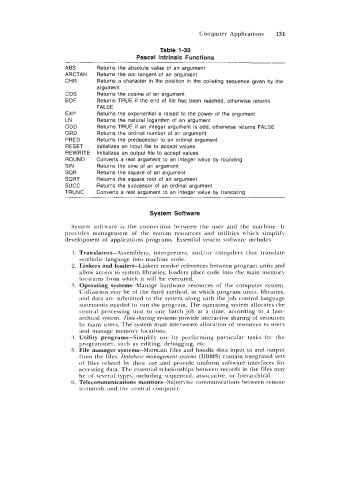
                                                  Table 1-30
                                           Pascal Intrinsic Functions
                     ABS      Returns the  absolute  value  of  an argument
                     ARCTAN    Returns the  arc tangent  of  an argument
                     CHR       Returns a character  in the  position  in the collating sequence  given  by  the
                              argument
                     cos       Returns the cosine of  an argument
                     EOF       Returns TRUE  if the  end of  file  has been reached, otherwise  returns
                               FALSE
                     EXP       Returns the  exponential  e  raised to the  power of  the  argument
                     LN        Returns the  natural  logarithm of  an  argument
                     ODD       Returns TRUE  if  an integer argument  is odd,  otherwise  returns  FALSE
                     ORD       Returns the  ordinal  number of  an argument
                     PRED     Returns the  predecessor to an ordinal argument
                     RESET     Initializes an  input file to  accept values
                     REWRll -E  Initializes an output  file to  accept values
                     ROUND    Converts a  real argument  to  an integer value  by  rounding
                     SIN      Returns the  sine  of  an  argument
                     SQR       Returns the  square of  an argument
                     SQRT     Returns the square  root of  an argument
                     succ     Returns the  successor of  an ordinal  argument
                     TRUNC    Converts a  real argument to  an integer value  by  truncating


                                               System Software
                       System  software  is  the  connection  between  the  user  and  the  machine.  It
                     provides  management  of  the  system  resources  and  utilities  which  simplify
                     development  of  applications programs.  Essential  system  software includes
                       1.  Translators-Assemblers,  interpreters,  and/or  compilers  that  translate
                         symbolic language  into  machine  code.
                       2. Linkers and loaders-Linkers  resolve  references between program units and
                         allow  access  to  system libraries; loaders place code into the main  memory
                         locations from  which  it will  be executed.
                       3.  Operating systems-Manage  hardware  resources  of  the  computer  system.
                         Utili~ation may be of  the batch  method, in which  program units, libraries,
                         and data  are submitted  to  the  system  along with  the job control language
                         statements needed to run the program. The operating  system allocates the
                         central  processing  unit  to  one  batch job at  a  time,  according  to  a  hier-
                         archical  system.  Time-sharing systems provide interactive sharing of resources
                         by  many  users. The system must interweave  allocation of resources to users
                         and manage  memory locations.
                       4. Utility  programs-Simplify  use  by  performing  particular  tasks  for  the
                         programmer, such as  editing,  debugging,  etc.
                       5.  File manager systems-Maintain  files and handle data input to and output
                         from the files. Database  management  systems  (DBMS) contain integrated sets
                         of  files  related  by  their  use  and  provide  uniform  software interfaces  for
                         accessing data. The essential relationships between records in the files may
                         be of several  types,  including  sequential,  associative, or hierarchical.
                       6.  Telecommunications monitors-Supervise  communications between  remote
                         terminals  and  the  central  computer.

